Language
 永住申請お役立ちコラム

What Is the Highly Skilled Professional Points System? Its Connection to the Permanent Residence Visa Explained
- 2026年04月30日
Full Support for Japanese Permanent Residency Applications!

Operated by: Touch Immigration Law Firm

目次
This content is also explained in the video below. Please take a look.
“Permanent Resident” is one of the statuses of residence (commonly known as visas) under the Immigration Control Act. It is also colloquially referred to as “permanent residency” or “permanent residence status.” The activities that foreign nationals living in Japan are permitted to engage in within Japan are restricted to the scope of their respective status of residence. However, “Permanent Resident” is the status of residence with the fewest activity restrictions, allowing nearly all activities in Japan. In addition, since the period of stay is unlimited, there is no need to file periodic applications for renewal of period of stay as is required for other statuses of residence.
A concept similar to “Permanent Resident” is “Naturalization.”
The key difference is that a “Permanent Resident” continues to reside in Japan as a foreign national, whereas “Naturalization” means becoming fully Japanese. Both allow you to live in Japan with nearly complete freedom, so there is little difference in that respect. However, unlike “Naturalization,” in which one fully becomes Japanese, a “Permanent Resident” remains a foreign national and therefore continues to be subject to regulation under the Immigration Control Act. This means that while Japanese nationality cannot be lost unless the person voluntarily renounces it, Permanent Resident status can be lost under the provisions of the Immigration Control Act even against the person’s wishes.
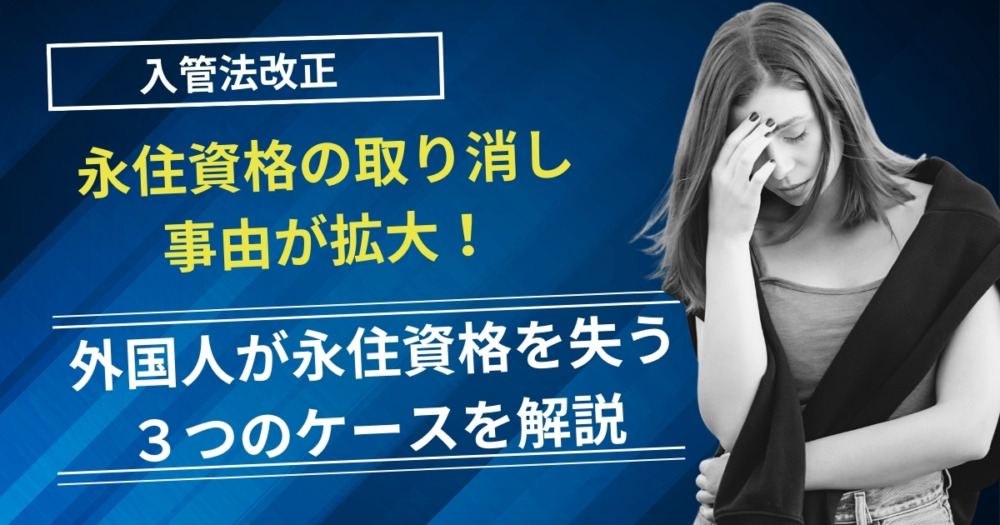
Specifically, there are three cases in which a Permanent Resident’s status of residence can be lost:
Even Permanent Residents will lose their status of residence if they leave Japan (simple departure) without obtaining a re-entry permit.
A re-entry permit is a permission granted by the Minister of Justice in advance of departure—when a foreign national intends to temporarily leave Japan and re-enter—to simplify the entry and landing procedures. For Permanent Residents, the maximum period is five years (six years for Special Permanent Residents). By applying to the Immigration Services Agency in advance and obtaining a re-entry permit, you can maintain your Permanent Resident status even after leaving Japan.
Note that if you re-enter Japan within one year of your departure, in principle no re-entry permit application is required (deemed re-entry permit). At the time of departure, by checking the box “I intend to re-enter Japan as this is a temporary departure” on the Embarkation/Disembarkation Card for Re-entrant (Re-entry ED Card) and presenting it to the immigration inspector, you can receive the effect of a one-year re-entry permit. Even without filing a re-entry permit application with the Immigration Services Agency, you can maintain your Permanent Resident status. However, even if you obtain a re-entry permit (including a deemed re-entry permit), if you do not return to Japan within its validity period, your Permanent Resident status will still be lost.
Deportation refers to the forced removal from Japan of foreign nationals who fall under the grounds for deportation (Article 24 of the Immigration Control Act). Even Permanent Residents can be forcibly removed from Japan, and as a result will lose their Permanent Resident status.
The main grounds for deportation include the following:
If the grounds for revocation of status of residence (each item of Article 22-4, Paragraph 1 of the Immigration Control Act) apply, even Permanent Resident status may be revoked.
The main grounds for revocation include the following:
The 2024 (Reiwa 6) amendment to the Immigration Control Act expanded the grounds for revocation of status of residence applicable to Permanent Residents.
This is believed to be because, after permanent residence permission is granted, there are no further residence examinations such as applications for renewal of period of stay, resulting in some Permanent Residents being observed to neglect tax payments or fail to comply with laws, with deteriorating conduct.
For example, in Toshima Ward, Tokyo, the delinquency rate for National Health Insurance premiums in fiscal year 2021 was 7.5% for Japanese nationals and 39.3% for foreign nationals. According to available data, the cumulative amount of delinquent payments by foreign nationals that became uncollectible due to the statute of limitations in fiscal year 2021 reached 238 million yen.
Let us now look at the expanded grounds for revocation. Note that Special Permanent Residents, whose status is based on a special law, are not subject to this amendment, as the above rationale does not apply to them.
While these are not grounds for deportation, obligations under the Immigration Control Act that are secured by penalties may become grounds for revocation if not fulfilled without justifiable reasons.
This expansion of grounds for revocation targets a small number of malicious Permanent Residents as described above, not the vast majority of Permanent Residents. Therefore, minor violations of the Immigration Control Act—such as inadvertently failing to carry one’s residence card or unintentionally forgetting to renew the validity period of one’s residence card—are not anticipated to result in revocation of Permanent Resident status.
Taxes and public dues are also limited to cases of intentional non-payment. Revocation is not anticipated in cases of accidental oversight, or unavoidable inability to pay due to illness or similar reasons.
“Taxes and public dues” (公租公課 / kōso kōka) is a general term for monetary burdens imposed by the national or local government, also called “sozei kōka” (租税公課). “Public taxes” (公租) refers to taxes such as corporate tax, income tax, and resident tax, while “public dues” (公課) include non-tax monetary burdens such as health insurance premiums and social insurance premiums.
Unlike the grounds for deportation, there is no restriction on the length of the sentence, but the applicable crimes are limited to serious ones such as murder, robbery, theft, fraud, and dangerous driving resulting in death or injury.
Revocation is not anticipated for Permanent Residents who commit crimes of low illegality due to negligence, or mere traffic violations.
Even if a situation potentially meeting the grounds for revocation of status of residence arises, the status of residence will not be revoked immediately.
Status of residence will be revoked only after the necessary administrative procedures have been carried out, and only when revocation is determined to be appropriate.
Furthermore, under this amendment, when a Permanent Resident meets the grounds for revocation, rather than immediately revoking the status of residence and requiring departure, the Minister of Justice will, ex officio, grant permission to change to a status of residence other than Permanent Resident. The specific status of residence to be changed to is determined on a case-by-case basis for each foreign national based on residence status and activity status. In many cases, “Long-Term Resident” status is expected to be granted, allowing continued residence in Japan.
However, in cases where it is clear that the intention not to pay taxes and public dues persists, or where criminal tendencies are pronounced—if it is deemed inappropriate for the foreign national to continue residing in Japan, no change to another status of residence will be granted, and as a result of the revocation of Permanent Resident status, the person will depart from Japan.
Even if a Permanent Resident’s status of residence is revoked, their family members’ statuses of residence will not be revoked along with it.
For example, if the spouse or child of a person whose Permanent Resident status has been revoked holds the “Permanent Resident” status of residence, they may continue to live in Japan as Permanent Residents. If they hold the “Spouse or Child of Permanent Resident” status, they may change their status of residence to “Long-Term Resident” or similar as appropriate, and continue to live in Japan.
Under Article 62-2 of the amended Immigration Control Act, when officials of the national or local government become aware, in the course of performing their duties, of a foreign national who may meet the grounds for revocation of status of residence, they may report this fact.
This provision also follows the rationale described above. It is not anticipated that simply visiting a government office to consult about paying forgotten taxes and public dues would lead to being reported. If you have difficulties or concerns about paying taxes and public dues, please be sure to consult the relevant administrative agency. If you have concerns about your own status of residence, it is important to consult the Foreign Residents Support Center (FRESC) helpdesk. Leaving unclear matters unresolved or intentionally hiding them is more likely to lead to revocation of Permanent Resident status.
Our office accepts consultations on a wide range of issues related to Permanent Resident status.
In most cases, the loss of Permanent Resident status can be avoided with just a little care. If you have any concerns, please consider using “Administrative Scrivener Corporation Touch”.
Free consultation appointments can be booked by phone or through our inquiry form. If you have any concerns, please feel free to contact us.
永住申請お役立ちコラム
永住申請お役立ちコラム

永住申請お役立ちコラム

永住申請お役立ちコラム


| August 2018 | Established “Yuda Administrative Scrivener Office,” specializing in visa applications and naturalization applications |
|---|---|
| April 2022 | Incorporated the private office as “Touch Immigration Law Firm” |
| Areas of Expertise | Foreign nationals’ statuses of residence and naturalization applications Specializes in foreign national visa-related matters and handles more than 1,000 consultations annually |
| Seminar Experience | Numerous seminars, including the International Administrative Scrivener Training Course, Toda City International Exchange Foundation, Saitama Japanese Language Network, Administrative Scrivener TOP 10% Club, and work visa training seminars for administrative scriveners |
| Operated Websites | Touch Immigration Law Firm International Marriage & Spouse Visa Support Center Naturalization Application Support Center Work Visa Support Center Permanent Resident Visa Support Center Business Manager Visa Support Center U.S. Visa Support Center Visa Support Center |
For a smooth application, start with a free consultation