
Insights
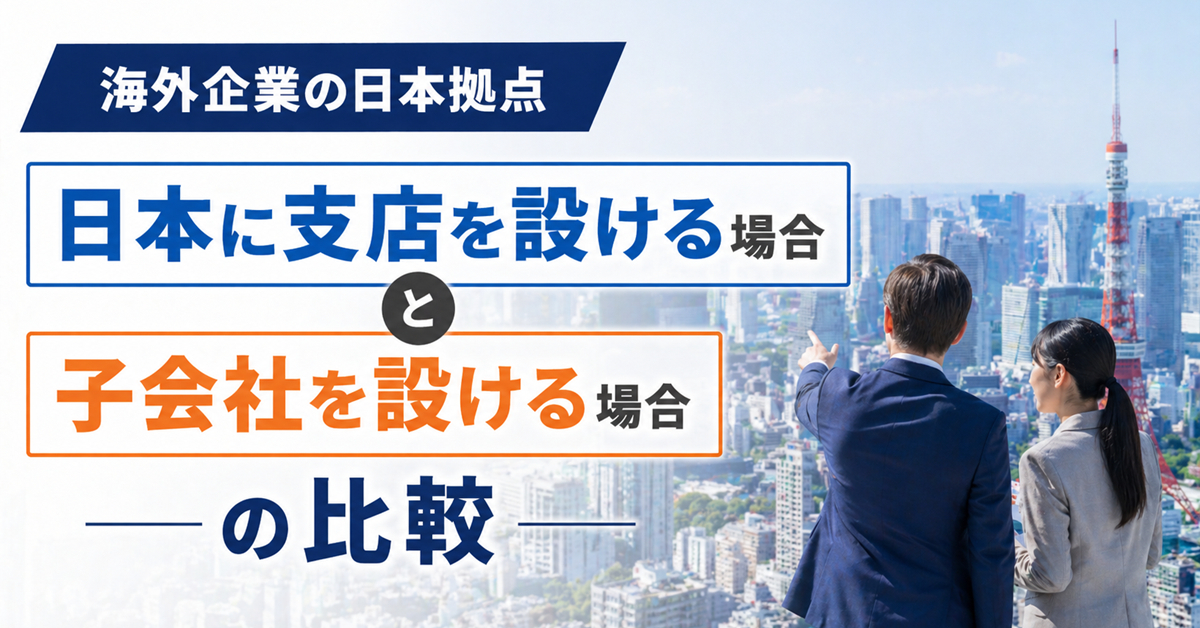
Setting Up a Branch vs. a Subsidiary in Japan: A Comparison
- 2026年04月27日


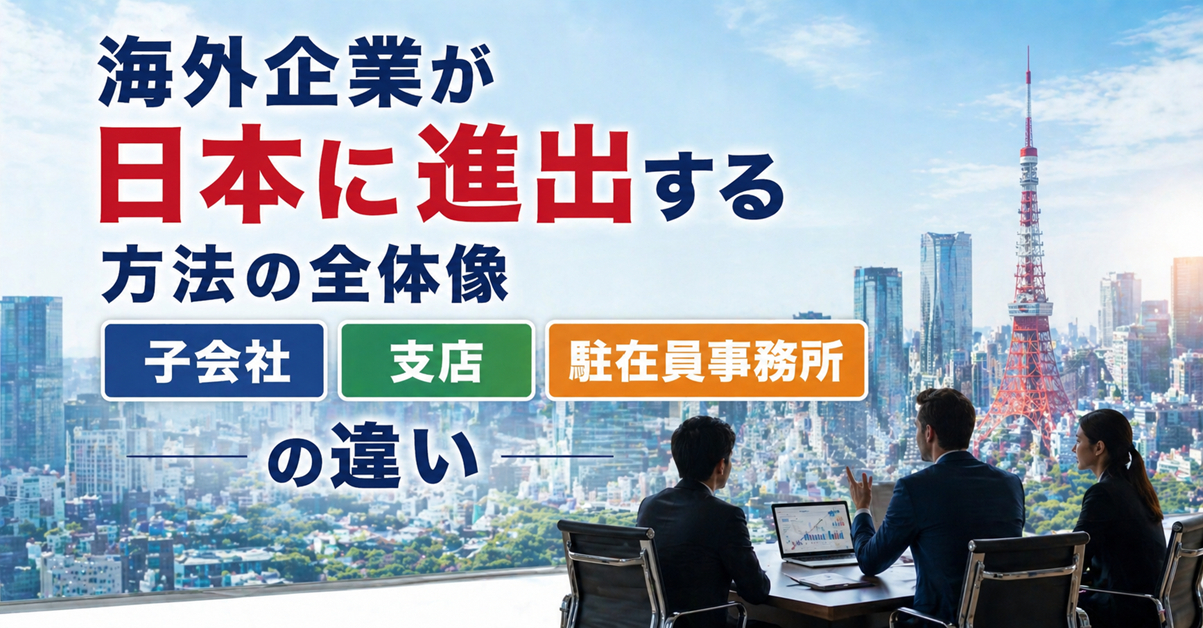
For overseas companies considering expansion into Japan, the first hurdle is the choice of “what form to establish a presence in Japan in.” Broadly speaking, there are three methods: setting up a subsidiary (a Japanese corporation), establishing a branch, and opening a representative office. Each has different advantages and disadvantages, and the optimal choice changes depending on the nature and purpose of the business.
This article lays out the differences among these three forms of entry and explains in detail which method suits which kind of company, drawing in the perspectives of setup procedures, tax, and visas.
A subsidiary is a method of newly setting up an independent corporation within Japan, separate from the overseas parent company. It is the most common form of entry, and in most cases it is set up as a joint-stock company (KK) or a limited liability company (GK).
Legal independence is its greatest characteristic. Because a subsidiary is an independent corporation under Japanese law, it can fully carry out business activities in Japan—entering into contracts, opening bank accounts, hiring employees, obtaining licenses, and so on. In addition, because it is legally separated from the parent company, any debts or legal risks the subsidiary incurs do not, in principle, extend to the parent. This is also an important point from the standpoint of risk management.
Flow of the Setup Procedure (for a Joint-Stock Company)
When setting up a joint-stock company as a subsidiary, the procedure proceeds roughly in the following flow.
First, you decide on the company’s basic information (trade name, head-office location, business purpose, capital, the makeup of the officers, and so on) and draw up the articles of incorporation. The articles require notarization by a notary public. Next, you pay in the capital and apply to the Legal Affairs Bureau for registration of incorporation. When registration is complete, the corporation is formally established, after which you make notifications to the tax office, the prefecture, and the municipality, carry out the procedures to enroll in social insurance, and so on.
From setup to the completion of registration usually takes around two to four weeks even when things go smoothly. It can take longer when the representative resides overseas or when gathering the required documents takes time.
A branch is a form in which the overseas head office (the foreign company) establishes a business base within Japan as itself. Rather than setting up an independent corporation in Japan, you register with the Japanese Legal Affairs Bureau as part of the foreign company.
Unlike a subsidiary, a branch is legally one and the same as the head office. Transactions the branch enters into and debts it incurs ultimately belong to the head office. For that reason, you need to be careful that the branch’s activities tie directly into the head office’s risk.
For branch registration, you prepare the foreign company’s certificate of registration, articles of incorporation, documents concerning its officers, and so on, attach Japanese translations, and apply to the Legal Affairs Bureau. Because there are many foreign-language documents and notarization and authentication procedures in each country are required, it is not uncommon for gathering documents to take time. You must also designate a representative in Japan (the “representative in Japan”), and that person is required to have an address within Japan.
A representative office is a base that does not conduct business activities in Japan. It is an office for the purposes of market research, information gathering, and liaison and coordination with the head office, and it cannot directly conduct transactions that generate sales in Japan.
Registration with the Legal Affairs Bureau is not required, making it the form with the lowest barrier to establishment. However, the constraint of being prohibited from business activities is strict, and once you reach the stage of actually running a business, transitioning to a subsidiary or a branch becomes necessary.
| Item | Subsidiary (Japanese Corporation) | Branch | Representative Office |
| Legal independence | Yes (an independent corporation) | No (one with the head office) | No |
| Business activities | Possible | Possible | Not possible |
| Obtaining licenses | Possible | Depends on conditions | Not possible |
| Setup cost | Higher | Moderate | Low |
| Spillover of risk to the head office | Limited | Spills over directly | Limited |
| Registration | Required | Required | Not required |
The tax treatment also differs depending on the form of entry.
A subsidiary, being independent as a Japanese corporation, is subject to Japanese corporate tax on income arising within Japan. For dividend remittances to the parent company, the withholding tax rate can change depending on the terms of the tax treaty.
For a branch, income earned within Japan is taxed, the same as a subsidiary, but its characteristic is that transfer pricing issues regarding transactions with the head office (internal transactions) and the treatment of cost allocation between head office and branch tend to become complex. In addition, a tax burden may arise on remittances of profit from the branch to the head office (remittance interest).
A representative office, in principle, does not generate revenue, so usually no taxation relationship arises in Japan. However, if it is deemed to be conducting business activities in substance, there is a possibility of being taxed as a permanent establishment (PE).
Because tax treatment also differs depending on the nature of the business and the parent company’s country of location, we recommend advancing consultation with a Japanese tax accountant in parallel. Because the choice of form of entry can in some cases be hard to change later, it is important to check the tax issues at the pre-setup stage.
Though it tends to be overlooked, the form of expansion into Japan is also deeply connected with the status of residence (visa) application for the representative and resident staff.
For example, if a subsidiary or a branch has been set up, the preconditions are in place for the representative to apply for the “Business Manager” status of residence (the so-called Business Manager visa). Obtaining a Business Manager visa, in principle, requires the existence of a corporation (or branch) established in Japan, and the recognition of business substance is a key point in the review.
On the other hand, in the case of a representative office, because its activities are judged not to fall under business acts, obtaining a Business Manager visa becomes difficult. There are cases of using the “Intra-company Transferee” status of residence, but the requirements and the perspectives of the review differ.
In this way, the form of corporate setup and obtaining the visa need to be thought of as a set. Because cases of stumbling at the visa application after advancing the setup procedures are not uncommon in practice, it is important to organize both issues from the very first stage.
Finally, here are a few failure patterns often seen in the practice of expanding into Japan.
Assuming that “as long as you set up the company, you’ll be fine”
Setting up the company is nothing more than the start. In industries that require a license, business becomes possible only after going through a license application following setup. Also, because the representative’s arrival in Japan requires obtaining a visa, the arrangement of advancing setup and the visa application in parallel is indispensable. Because decisions made at the time of setup—such as the amount of capital and the substance of the office—can affect the visa review as well, judgment that looks at the whole picture from the very first stage is called for.
Putting off document preparation
In the case of establishing a branch, the translation and authentication of foreign-language documents can take more time than expected. Also, in a Business Manager visa application, preparing the business plan and documents showing business substance is important. Trying to scramble to put these together later can delay the schedule significantly, so it is important to identify the required documents early.
Consultations with specialists becoming siloed
While you consult separately with different specialists—a judicial scrivener for registration, a tax accountant for tax, an administrative scrivener for the visa—there are cases where overall consistency is lost. For example, even though you entrusted registration of incorporation to a judicial scrivener, the preparation of the business substance needed for the visa application falls behind, and as a result the visa review drags on. Because multiple procedures are interlinked in expanding into Japan, having a point of contact that can organize the whole thing collectively is the shortest path to a smooth entry.
The methods by which an overseas company expands into Japan can be broadly divided into three: a subsidiary, a branch, and a representative office. Correctly understanding the characteristics of each, and then organizing the issues of business content, schedule, cost, and visa together, is the first step to a smooth expansion into Japan.
If you “don’t know which form suits your company” or “want to organize what is needed besides setting up the company,” we recommend starting with a consultation with a specialist. At Touch Immigration Law Firm, we offer a free initial consultation and provide guidance after organizing the practical work required for expanding into Japan from a holistic perspective.
Insights
Insights

Insights
Insights


| August 2018 | Established “Yuda Administrative Scrivener Office,” specializing in visa applications and naturalization applications |
|---|---|
| April 2022 | Incorporated the private office as “Touch Immigration Law Firm” |
| Areas of Expertise | Foreign nationals’ statuses of residence and naturalization applications Specializes in foreign national visa-related matters and handles more than 1,000 consultations annually |
| Seminar Experience | Numerous seminars, including the International Administrative Scrivener Training Course, Toda City International Exchange Foundation, Saitama Japanese Language Network, Administrative Scrivener TOP 10% Club, and work visa training seminars for administrative scriveners |
| Operated Websites | Touch Immigration Law Firm International Marriage & Spouse Visa Support Center Naturalization Application Support Center Work Visa Support Center Permanent Resident Visa Support Center Business Manager Visa Support Center U.S. Visa Support Center Visa Support Center |
日本進出に関して知りたいなら
まずは無料相談をご活用ください。
全国対応。企業様、監理団体様、登録支援機関様、それぞれの課題を解決する
サポートをご用意しております。

Concerns About Expanding
into Japan?
Please Start with
a Free Consultation
Nationwide / Multilingual Support