Language


永住申請お役立ちコラム
Complete Guide to the Three Requirements for Permanent Residency in Japan | Updated for the 2026 Guidelines
- 2026年06月24日
Full Support for Japanese Permanent Residency Applications!

Operated by: Touch Immigration Law Firm

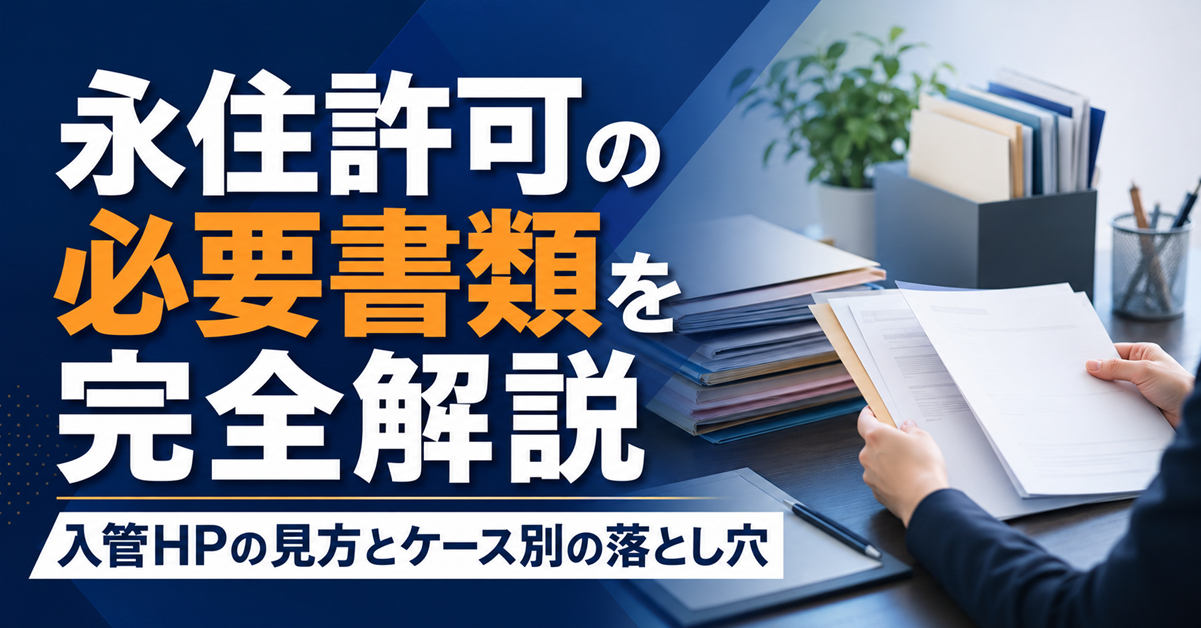
Preparing the required documents for a permanent residency application is highly complex, and we often receive inquiries from applicants who are unsure what documents they need and where to obtain them. Simply collecting the documents can take 2 to 3 months, and applicants with a history of moving or changing jobs may need even more time.
In this article, an administrative scrivener provides a complete explanation of the 15 types of documents required for all applicants, additional documents by status of residence, and the four common document-collection pitfalls that frequently cause problems in practice. If you are preparing to apply for permanent residency, we recommend keeping this article at hand and gathering your documents in a planned manner.
目次
The content of this article is also explained in detail through a video by Yuda, representative of Touch Immigration Law Firm. If you prefer learning through video rather than text, please watch it as well.
The required documents for permanent residency applications can be broadly divided into 3 categories.
| Document Category | Main Contents |
| ① Documents Common to All Applicants | Application form, ID photo, statement of reasons, certificate of employment, residence record, tax payment certificates, pension records, letter of guarantee, consent form, copies of bank passbooks, etc. (15 types) |
| ② Additional Documents by Status of Residence | Additional documents required depending on the applicant’s category, such as spouse of a Japanese national, spouse of a permanent resident, Long-Term Resident, Business Manager, Highly Skilled Professional, or Family Stay |
| ③ Optional Documents | Written explanation of circumstances, such as for addressing disadvantageous factors |
The first category is documents required for all applicants. There are 15 types.
The second category is additional documents by status of residence. The required additional documents vary depending on whether the applicant is the spouse of a Japanese national, spouse of a permanent resident, a Business Manager, Highly Skilled Professional, Family Stay visa holder, and so on.
The third category is optional documents that are not mandatory but may improve the likelihood of approval if submitted. A typical example is a written explanation of circumstances.
The following 15 types of documents are commonly required from all applicants in permanent residency applications.
| No. | Document Name | Key Point |
| 1 | Application for Permanent Residence Permit | Download from the Immigration Services Agency website |
| 2 | ID Photo | 4cm high × 3cm wide, taken within 3 months before application, no hat, plain background |
| 3 | Certificate of Employment of the applicant or the person supporting the applicant | For self-employed applicants, submit a copy of the filed tax return; also attach a copy of a business permit if available |
| 4 | Residence record for all family members in the household, including the applicant | Omit My Number; all other items should be listed |
| 5 | Resident tax taxation or tax exemption certificates and tax payment certificates | Most recent 5 years, with shorter periods depending on the applicant category |
| 6 | Tax Payment Certificate No. 3 | Issued by the tax office. Certifies that there are no unpaid amounts for 5 national tax categories |
| 7 | Copies of bank passbooks | Submitted as evidence of income and assets |
| 8 | Documents proving payment status of public pension premiums | Most recent 2 years, with shorter periods depending on the applicant category |
| 9 | Documents proving payment status of public health insurance premiums | Most recent 2 years, with shorter periods depending on the applicant category |
| 10 | Passport and Residence Card | Presented at the counter when applying; presentation only, not submission |
| 11 | Letter of Guarantee | Download from the Immigration Services Agency website. Ask a Japanese national or permanent resident to complete it |
| 12 | Document identifying the guarantor | Copy of a driver’s license, etc. |
| 13 | Statement of Reasons | Write freely about why permanent residency is needed |
| 14 | Consent Form | Document pledging to report changes in circumstances |
| 15 | Permanent Residency Application Self-Check Sheet | If even one item is marked No, the risk of refusal is high |
We will now provide supplementary explanations for each of these 15 common document types.
① The Application for Permanent Residence Permit is a standard form that can be downloaded from the Immigration Services Agency website.
② The ID photo must be 4cm high × 3cm wide, taken within 3 months before application, with no hat and a plain background. To avoid mistakes, select the “visa” or “status of residence” option when using an ID photo machine. Applicants under 16 years old do not need to submit a photo.
Document ③ is the certificate of employment of the applicant or the person supporting the applicant. For example, if you are working on a work visa, you should obtain your own certificate of employment. If you came to Japan under Family Stay and your spouse supports the household through employment, you should obtain the certificate of employment of that spouse, who is the supporter.
Self-employed applicants should submit a copy of their filed tax return instead of a certificate of employment. If you have a business permit, attach a copy of that as well.
For document ④, you need a residence record for the entire household, not just the applicant. My Number should be omitted, but all other items should be listed.
⑤ The resident tax taxation certificate, or tax exemption certificate, and resident tax payment certificate are issued by the municipality. As a general rule, the most recent 5 years are required, although this may be shortened to 3 years or 1 year depending on the applicant’s category.
⑥ The Tax Payment Certificate No. 3 is easily confused with the above, but it is a separate document issued by the tax office. It certifies that there are no unpaid national taxes, such as income tax, consumption tax, inheritance tax, and gift tax, across 5 national tax categories. Although there are also certificates No. 1 and No. 2, only No. 3 is required for permanent residency applications. We explain this in detail in Chapter 4, “Pitfalls.”
Document ⑦ is copies of bank passbooks. These are submitted as income and asset documents to show that the applicant satisfies the independent livelihood requirement for permanent residency, meaning that they have the financial foundation to support themselves. Prepare copies that show deposits and withdrawals for approximately the most recent 1 year. Printed online bank passbook screens are also acceptable.
For ⑧ pension and ⑨ health insurance payment status documents, the general rule is the most recent 2 years. Pension records can be proven through Nenkin Net or inquiry forms issued by a pension office. Health insurance can be proven through receipts or payment certificates. We explain this in detail in Chapter 4, “Pitfalls.”
For ⑩, the passport and residence card only need to be presented at the counter when applying. Copies do not need to be submitted. Presentation and submission are different, so please do not confuse them.
⑪ The letter of guarantee is completed and signed by the guarantor using the form downloadable from the Immigration Services Agency website. The guarantor should be a Japanese national or permanent resident.
⑫ For the document identifying the guarantor, a copy of a driver’s license or similar document is sufficient.
Previously, the guarantor’s certificate of employment, resident tax taxation certificate, withholding tax slip, and similar documents were also required. However, after the form revision in June 2022, the requirements were significantly simplified, and now only a copy of an identification document is needed.
The Immigration Services Agency’s required document list simply states that the statement of reasons is in “free format,” and no specific form is designated.
In fact, a statement of reasons is not mandatory for every permanent residency application. For example, applicants with the status of Spouse of a Japanese National, etc., for whom submission is optional, do not necessarily need to submit one.
On the other hand, for applicants applying for permanent residency from work-related statuses such as Engineer/Specialist in Humanities/International Services, Skilled Labor, or Intra-company Transferee, the statement of reasons is both mandatory and important. Because the way it is written can significantly affect the result, we provide a full explanation in our separate article, “How to Write a Statement of Reasons for Permanent Residency|Explained by an Administrative Scrivener with Sample Text by Pattern.” Please refer to it as well.
⑭ The consent form became a required document for permanent residency applications on October 1, 2021, and can be downloaded from the Immigration Services Agency website.
Its content is a pledge by the applicant stating, “I understand that if any of the following changes occur during the examination of my permanent residency application, I will promptly report them to immigration.” Reportable changes include the following.
Sign the Consent Form Only After Understanding the Weight of the Responsibility
If it is later discovered that permanent residency was granted without reporting these changes, the permanent residency permit may be revoked. Among the submitted documents, this is one that should be signed only after understanding the seriousness of the responsibility.⑮ is the “Permanent Residency Application Self-Check Sheet” created and provided by Touch Immigration Law Firm. This sheet allows you to easily check whether you meet the requirements and whether there are any disadvantageous factors before applying for permanent residency.
If even one item is marked “No,” the risk of refusal is high
This sheet comprehensively checks important requirements and pitfalls in permanent residency applications. If even one item is marked “No,” there is a high possibility that the application will be refused.
Please use it to check your own situation before applying. The sheet can be downloaded from the URL below.▶ Download the Permanent Residency Application Self-Check Sheet
Next, let us look at additional documents required according to the applicant’s status of residence, in addition to the 15 common documents.
| Status of Residence | Main Additional Documents |
| Spouse or Child of Japanese National | Spouse’s family register transcript |
| Spouse or Child of Permanent Resident | Marriage certificate |
| Long-Term Resident | Documents proving status relationship, such as family register transcript, birth certificate, or marriage certificate |
| Business Manager | Company registration certificate, financial statements, and copies of receipts for company health insurance and employees’ pension insurance premiums for the most recent 2 years |
| Current Highly Skilled Professional | Notification of calculation result, points calculation table, and documents proving current points |
| Deemed Highly Skilled Professional | Points calculation table and documents proving that the applicant has continuously held the required points since 3 years or 1 year ago |
| Family Stay | Documents proving status relationship, such as family register transcript, birth certificate, marriage certificate, or certificate of matters stated in an acknowledgment notification |
Applicants with the status of “Spouse or Child of Japanese National” who have been married for at least 3 years and have continuously resided in Japan for at least 1 year must obtain, in addition to the 15 common document types, the family register transcript of the Japanese spouse. A family register transcript can be obtained from the municipal office of the registered domicile. Recently, it can also be obtained at convenience stores using a My Number card.
Applicants with the status of “Spouse or Child of Permanent Resident” must additionally submit a marriage certificate. A marriage certificate issued in the home country should be submitted together with a Japanese translation.
For spouse visa holders, the standard practice is for the Japanese national or permanent resident spouse to serve as the guarantor.
Long-Term Residents must submit, in addition to the common documents, documents clarifying their status relationship. Specifically, prepare documents such as family register transcripts, birth certificates, or marriage certificates that show the circumstances under which the applicant resides as a Long-Term Resident.
Applicants managing a company under a Business Manager visa need a relatively large number of additional documents: the company registration certificate, financial statements for the most recent two years, and copies of receipts for company health insurance and employees’ pension insurance premiums for the most recent two years.
In permanent residency applications from Business Manager status, immigration examines not only the applicant’s own income and tax payment status, but also whether the company being managed is operating stably and whether social insurance premiums have been properly paid.
Applicants applying for permanent residency from Business Manager status will not be granted permanent residency unless they satisfy the new requirements for the Business Manager visa. Please refer to the article below for details on the new requirements.
Highly Skilled Professional applicants fall into 2 categories: those who currently hold Highly Skilled Professional status, and those who previously had enough points to qualify as a Highly Skilled Professional, known as “deemed Highly Skilled Professionals.”
Applicants currently holding “Highly Skilled Professional No. 1” or “Highly Skilled Professional No. 2” status should prepare the notification of calculation result, points calculation table, and documents proving current points.
On the other hand, applicants whose current status is not Highly Skilled Professional but who apply for permanent residency as “deemed Highly Skilled Professionals” with 70 or 80 points or more must submit, in addition to the points calculation table, documents proving that they have continuously held the required points since 3 years ago or 1 year ago. Because this requires collecting past proof documents retroactively, we recommend starting preparations several months before application.
Applicants who came to Japan under Family Stay status must submit, in addition to the 15 common document types, documents proving the applicant’s status relationship. Specifically, submit one of the following: family register transcript, birth certificate, marriage certificate, or certificate of matters stated in an acknowledgment notification.
Family Stay applicants are financially supported by the spouse who works, so the “certificate of employment” in common document ③ should be the certificate of employment of the spouse who is the supporter.
This is the most important section of this article. We will explain in detail the 4 document-collection pitfalls that many applicants struggle with in practice.
| No. | Problematic Document | What Makes It Difficult |
| ① | Resident tax taxation certificate and tax payment certificate | Can only be obtained from the municipality where your address was registered as of January 1 |
| ② | Tax Payment Certificate No. 3 | A national tax certificate issued by the tax office. Often confused with the resident tax payment certificate |
| ③ | Pension records | Nenkin Teikibin is NG. Nenkin Net or three types of inquiry forms issued by the pension office are required |
| ④ | National Health Insurance premiums | Receipts must be kept or a payment certificate must be obtained |
Resident tax taxation or tax exemption certificates and tax payment certificates can be obtained from the municipality where your address was registered as of January 1 of that year.
In other words, they can only be obtained from the municipality where your residence record was located as of January 1 of each year. If you moved multiple times in the past five years, you will need to request documents from your previous municipalities as well.This is a very common issue. Many applicants say, “I went to the city office where I currently live to get all 5 years’ worth of documents at once.” However, resident tax documents can only be obtained from the municipality where your address was registered as of January 1 of that year.
For example, if you moved from City A to City B three years ago, City B can only issue documents for 3 years. The remaining 2 years must be obtained separately from City A. If you have a history of moving, we recommend starting early.
The “resident tax payment certificate” and “Tax Payment Certificate No. 3” are completely different documents.
Because the names are similar, many applicants mistakenly believe they can obtain everything from the municipality.
The “Tax Payment Certificate No. 3” proves that there are no unpaid “national taxes,” such as income tax, consumption tax, inheritance tax, and gift tax. It is issued by the tax office with jurisdiction over your address. It can be obtained at the tax office counter or by mail.
Company employees rarely pay income tax or consumption tax directly, so some may think it does not apply to them. However, this document is mandatory for all permanent residency applicants, so be sure to obtain it.
The pension records required for a permanent residency application must show the payment status for every month.
The annual “Nenkin Teikibin” notice does not provide sufficient monthly payment details and is generally not accepted.
Instead, prove your pension payment status using one of the following.
At our office, this is the most common point where applicants who prepared documents themselves get stuck. Many people bring the Nenkin Teikibin notice and say, “This was delivered to my home.” However, permanent residency applications require more detailed monthly payment status.
Our recommendation is to register for the “Nenkin Net” website and save the “Monthly Pension Records” page as screenshots or export it as a PDF. If you have a My Number card, you can register quickly.
If you cannot use Nenkin Net, please visit a pension office and request the following three documents: “Insured Person Record Inquiry Response Form,” “Insured Person Record Inquiry (Payment I),” and “Insured Person Record Inquiry (Payment II).” If you bring identification documents, they can generally be issued on the spot.
If you are enrolled in National Health Insurance, you need proof of premium payments for the most recent 2 years.
As a general rule, you should keep all monthly or installment “receipts.”
Company employees enrolled in employee health insurance can submit a copy of their health insurance card or similar document.
Applicants enrolled in National Health Insurance, such as sole proprietors, self-employed individuals, and freelancers, need to be especially careful here.
National Health Insurance premiums are paid by bank transfer or by payment slips at counters or convenience stores, but you must keep all of the receipts.
Company employees enrolled in social insurance can submit a copy of their health insurance card or similar document.
So far, we have explained documents that are required for the application. Next, we will discuss optional documents that are not mandatory but may be worth submitting.
One optional document is the “written explanation of circumstances.” This is a document used by applicants who have circumstances that may be disadvantageous in a permanent residency application to explain the background and any improvements made.
However, there is a very important premise to understand.
It is rare for a written explanation of circumstances to fully recover from a disadvantageous factor.
In particular, applicants who have had late payments of public dues——that is, delays in paying pension premiums, resident tax, or health insurance premiums, are, under current practice, almost always refused no matter how carefully the explanation is written.
The only exceptional case approved by our office involved a situation where the applicant could prove with objective evidence, such as hospitalization records, that they were physically unable to pay by the deadline because they were hospitalized. Other ordinary reasons, such as “I forgot,” “there was insufficient balance in my account,” or “I was busy during job-change procedures,” are realistically very difficult to recover from through a written explanation.
Therefore, if you have past late payments of public dues, the most reliable response is not to rely on a written explanation, but to apply only after a clean period with no late payments has passed. For example, for late pension premium payments, wait until 2 years have passed from the month of the delay. For late resident tax payments, wait until 5 years have passed.
So who should submit a written explanation of circumstances?
Even so, a written explanation may still have value in cases such as the following.
Even in these cases, please understand that a written explanation is not a magic tool that erases the disadvantageous factor itself, but a way to properly organize and communicate facts that have already improved.
Finally, here is a final checklist for document preparation.
| Checklist Item | Key Point |
| When to start preparation | Start 2 to 3 months before the planned application date |
| Document validity period | As a general rule, documents must be issued within 3 months. Re-obtain old documents |
| How to check | Check off every item on the relevant list from the Immigration Services Agency website one by one |
Permanent residency application documents consist of a combination of 15 types of common documents, additional documents by status of residence, and an optional written explanation of circumstances.
Expert Comment
Simply collecting the documents can take 2 to 3 months. Applicants with a history of moving or changing jobs may need even more time. Because documents must generally be issued within 3 months, planning is extremely important. We also recommend using the self-check sheet introduced in this article to confirm your situation before applying.Please also see the other articles in our complete guide series on permanent residency applications.
Touch Immigration Law Firm offers free consultations for permanent residency applications. If you are having trouble preparing documents, have a history of moving or changing jobs that makes document collection complicated, or find it difficult to assess your case on your own, please feel free to contact us.
In particular, document preparation usually takes 2 to 3 months. If you are considering applying for permanent residency, we recommend consulting us early.
Please contact us anytime through the inquiry form on our website or by phone.
永住申請お役立ちコラム
永住申請お役立ちコラム

永住申請お役立ちコラム

永住申請お役立ちコラム

| August 2018 | Established “Yuda Administrative Scrivener Office,” specializing in visa applications and naturalization applications |
|---|---|
| April 2022 | Incorporated the private office as “Touch Immigration Law Firm” |
| Areas of Expertise | Foreign nationals’ statuses of residence and naturalization applications Specializes in foreign national visa-related matters and handles more than 1,000 consultations annually |
| Seminar Experience | Numerous seminars, including the International Administrative Scrivener Training Course, Toda City International Exchange Foundation, Saitama Japanese Language Network, Administrative Scrivener TOP 10% Club, and work visa training seminars for administrative scriveners |
| Operated Websites | Touch Immigration Law Firm International Marriage & Spouse Visa Support Center Naturalization Application Support Center Work Visa Support Center Permanent Resident Visa Support Center Business Manager Visa Support Center U.S. Visa Support Center Visa Support Center |
For a smooth application, start with a free consultation