

Insights
How to obtain a seal certificate and signature certificate for company establishment for a business management visa
- 2023年08月22日


When an overseas company or a foreign entrepreneur sets up a company in Japan, “what documents should I prepare” is a point you’ll want to grasp at the very start. There are many types of documents, and some take time to obtain, so it is important to organize the full picture early on.
This article lays out the documents and procedures required to set up a Japanese corporation (a joint-stock company [KK] or a limited liability company [GK]), including points to note when the representative resides overseas.
The documents required to set up a Japanese corporation can be broadly divided into “documents about the company” and “documents about the people.”
The articles of incorporation are the document that sets out the company’s basic rules. They state the trade name, head-office location, business purpose, capital, the makeup of the officers, and so on. In the case of a joint-stock company, they must be notarized by a notary public after being drawn up. In the case of a limited liability company, notarization is not required, but the articles must still be drawn up.
How the business purpose is written in the articles of incorporation also affects later license applications and the visa review. For example, in industries that require a particular license—such as food service, construction, or real estate—you may be unable to obtain the license if the purpose stated in the articles is not worded appropriately. We recommend entrusting the drafting of the articles to a specialist.
This is the document showing that payment of the capital has been completed. It is prepared based on the transfer details (such as a copy of the bankbook) for the deposit into the representative’s personal account. Because payment must be made after the articles of incorporation are notarized, you need to be careful about the order of the procedures.
This is the registration application submitted to the Legal Affairs Bureau. It states the company’s basic information (trade name, head-office location, capital, officers, and so on).
Registration and license tax is required for registration of incorporation. For a joint-stock company it is 0.7% of capital (minimum ¥150,000), and for a limited liability company it is 0.7% of capital (minimum ¥60,000).
This is the document showing that the representative director (in a joint-stock company) or the representative member (in a limited liability company) has accepted appointment to office. The person’s signature is required.
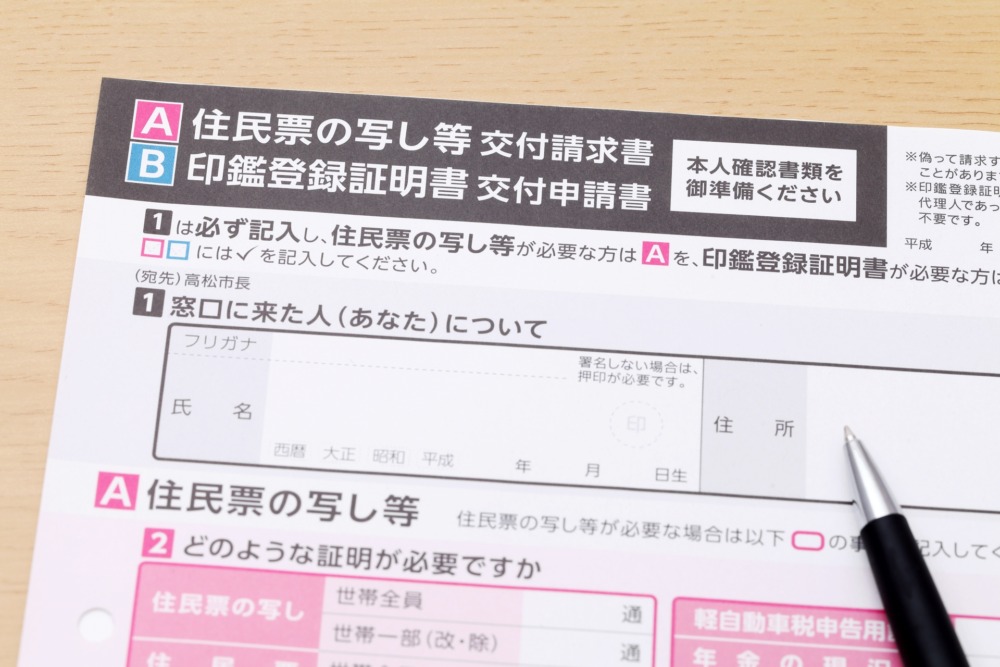
In Japanese corporate registration, the representative’s seal (registered seal) must be filed with the Legal Affairs Bureau (notification of seal). In addition, there are situations where a certificate of seal registration corresponding to that seal is also required as an attached document.
A person with a resident registration in Japan can register a seal at their municipal office and obtain a certificate of seal registration. On the other hand, a foreign national without a resident registration in Japan cannot obtain a Japanese certificate of seal registration. In this case, a procedure is needed to substitute it with a signature certificate (certificate of signature) issued by a notarial authority in their home country.
When the representative or an officer is a foreign national or an overseas resident, the following documents may additionally be required.
A copy of the passport is required as an identity verification document.
A foreign national living in Japan can use a copy of their residence card as an identity verification document.
As a substitute for the Japanese certificate of seal registration, there is a method of using a signature certificate (certificate of signature) issued by a Japanese overseas mission (a Japanese embassy or consulate). Obtaining it requires booking an appointment with, and visiting, the overseas mission, and in some countries it can take several weeks.
When a foreign corporation participates as an investor, submission of that corporation’s certificate of registration and articles of incorporation is required. Because these are written in a foreign language, Japanese translations must be attached. In addition, an apostille (authentication of foreign public documents) certifying the authenticity of the contents may be required.
An apostille is a system for authenticating foreign public documents based on the Hague Convention. Foreign public documents submitted to the Japanese Legal Affairs Bureau may require an apostille from the issuing country (or authentication by an embassy or consulate). Because an apostille is obtained from an authority in the issuing country, it can take time. The procedure is relatively smooth in countries party to the Hague Convention, but for non-party countries a separate procedure called consular authentication is required. Check in advance which category your country falls under.
Even after registration of incorporation is complete, the following documents and notifications are required.
| Notification Document | Where to Submit | Deadline |
| Notification of corporation establishment | Tax office | Within 2 months of setup |
| Notification of corporation establishment | Prefecture / municipality | Promptly after setup |
| Application for approval of blue-form tax return | Tax office | Within 3 months of setup, or the last day of the first fiscal year, whichever is earlier |
| Notification of establishment of a salary-paying office, etc. | Tax office | Within 1 month of starting salary payments |
| Notification Document | Where to Submit |
|---|---|
| Notification of new application for health insurance and employees’ pension insurance | Pension office |
| Notification of establishment of an employment-insurance-covered office | Hello Work (when hiring employees) |
| Notification of the establishment of a labor-insurance relationship | Labor Standards Inspection Office (when hiring employees) |
To open a corporate account, the requirements differ by financial institution, but the following documents are generally needed.
In recent years, from the standpoint of anti-money-laundering measures, the screening for opening accounts for foreign representatives and newly established corporations has become stricter. There are cases where you need to apply to multiple financial institutions, and cases where opening an account takes one to two months or more. It is important to begin the account-opening procedure early, before you need to move funds in and out for the launch of your business. A growing number of companies also make supplementary use of online banks and fintech-type payment services.
Separately from the company setup documents, license applications and the Business Manager visa application require their own documents. Here are the main ones.
| Document | Overview |
| Application for a Certificate of Eligibility | The application submitted to Immigration |
| Business plan | States the business content, income-and-expenditure plan, market analysis, etc. |
| Certificate of registered matters | Proof of corporate establishment |
| Office lease agreement | Proof of business substance |
| Most recent financial statements (for an existing corporation) | Proof of the continuity and stability of the business |
| Copy of the representative’s passport | Identity verification |
| The applicant’s certificates of education and work history | Proof of management ability |
In the Business Manager visa review, the content of the business plan is given particular weight. You need to state market analysis, concrete methods of attracting customers, income-and-expenditure projections, and the like in specific terms, and abstract content tends to make the review harder to pass. We recommend preparing it with the support of a specialist.
In the case of a construction business license, documents such as the following are required.
The required documents differ greatly depending on the type of license. It is important to check, at the pre-setup stage, which licenses your business needs and what their requirements and required documents are.
Arrange foreign-language documents early
Documents that must be obtained or handled overseas—such as obtaining an apostille, obtaining a signature certificate, and translating foreign-language documents—take time. Once you have firmly decided to set up the company, it is important to check the list of required documents right away and start making arrangements. In particular, procedures at overseas missions (embassies and consulates) often require an appointment, and during busy periods you may wait several weeks. When it comes to arranging documents, there is no such thing as “too early.”
Defects in documents can delay procedures significantly
If there is a defect in the registration application documents, the Legal Affairs Bureau will request a correction, and the procedure will be delayed. In particular, we recommend confirming in advance with a specialist regarding the accuracy of translations of foreign-language documents and whether an apostille is required. Once a defect arises, you may need to re-obtain and re-translate documents, which can cause losses on the order of several weeks. Using a specialist from the outset is more efficient overall.
Decide the business purpose in the articles of incorporation carefully
Once the articles of incorporation are drawn up and notarized, they are difficult to change, and changing them incurs additional costs. In practical terms, it is effective to state the business purpose to include not only your current business but also businesses you plan to develop in the future. For the wording of purposes in industries that require a license, it is important to have a specialist review it. Also, if the business purpose is too vague, it becomes difficult to explain in the license review or visa review, so a balance between specificity and comprehensiveness matters.
Pay attention to translation accuracy as well
Japanese translations of foreign-language documents require accuracy. There are cases where errors or unnatural expressions in the translation cause the review to take longer or lead to a request for correction. We recommend entrusting the translation of official documents to a professional translator or a specialist such as an administrative scrivener.
Keep an eye on the move toward digitalization
In recent years, the digitalization of administrative procedures has been advancing in Japan as well. Online applications to the Legal Affairs Bureau (electronic application for commercial registration) and electronic filing to the tax office (e-Tax) have spread, and the methods for submitting documents are changing too. That said, many situations still remain where paper-based handling is necessary, such as cases requiring foreign-language documents to be attached. We recommend confirming the latest procedural methods with a specialist.
The documents required to set up a Japanese corporation are wide-ranging, and when the representative resides overseas or is a foreign national, the arrangements become even more complex. Grasping the overall document list early, and prioritizing the arrangement of items that must be obtained overseas, is the shortest path to a smooth setup.
If you “don’t know what documents are needed” or “would like comprehensive support with document preparation and procedures,” please consult Touch Immigration Law Firm. The initial consultation is free, and we provide a full list of required documents tailored to your situation (nationality, place of residence, business content, and type of entry). By providing consistent support from the document-gathering stage, we can prevent delays and defects in the procedures. The earlier you start preparing documents for your expansion into Japan, the more breathing room you create. Please feel free to get in touch first.
Insights
Insights

Insights
Insights


| August 2018 | Established “Yuda Administrative Scrivener Office,” specializing in visa applications and naturalization applications |
|---|---|
| April 2022 | Incorporated the private office as “Touch Immigration Law Firm” |
| Areas of Expertise | Foreign nationals’ statuses of residence and naturalization applications Specializes in foreign national visa-related matters and handles more than 1,000 consultations annually |
| Seminar Experience | Numerous seminars, including the International Administrative Scrivener Training Course, Toda City International Exchange Foundation, Saitama Japanese Language Network, Administrative Scrivener TOP 10% Club, and work visa training seminars for administrative scriveners |
| Operated Websites | Touch Immigration Law Firm International Marriage & Spouse Visa Support Center Naturalization Application Support Center Work Visa Support Center Permanent Resident Visa Support Center Business Manager Visa Support Center U.S. Visa Support Center Visa Support Center |
日本進出に関して知りたいなら
まずは無料相談をご活用ください。
全国対応。企業様、監理団体様、登録支援機関様、それぞれの課題を解決する
サポートをご用意しております。

Concerns About Expanding
into Japan?
Please Start with
a Free Consultation
Nationwide / Multilingual Support