
Insights

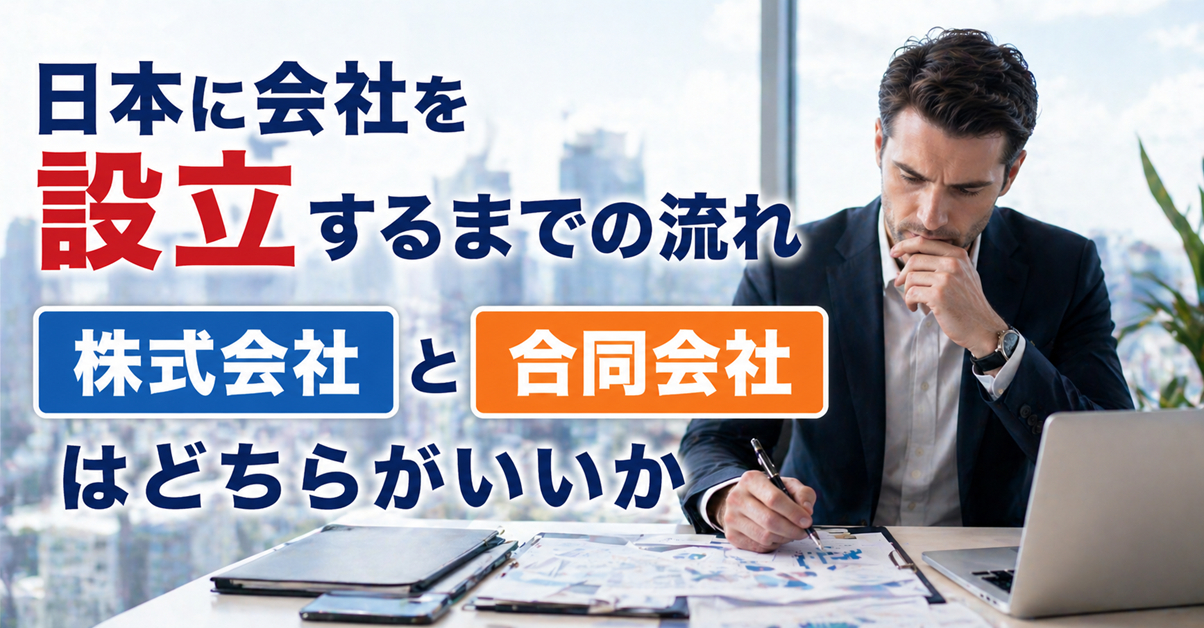
The Flow to Forming a Company in Japan — Hurdles Unique to Foreign Companies (Seals, Signature Certificates, Articles Notarization, BOJ Notification)
- 2026年07月01日



Once you have decided that “what we will set up in Japan is a subsidiary,” the next fork almost always awaits: “a stock company (KK), or a limited liability company (GK)?” Search online and the information conflicts — “a limited liability company is cheaper,” “no, a stock company has the credibility” — leaving many people unsure how to decide. Let us give you the key points first. Both are “companies” in which the investors’ liability is limited to the amount they invest. The differences lie mainly in external credibility and name recognition, the cost of formation and maintenance, and the flexibility of operations. And — a commonly misunderstood point — the requirements for the “Business Manager” status (the Business Manager visa) and the amount of corporate tax paid in Japan basically do not change depending on whether you choose a stock company or a limited liability company. In this article, an immigration lawyer specializing in international work organizes the differences between the two forms in a comparison, so you can identify “which direction fits our case.”
What you’ll learn in this article
The moment you choose the subsidiary form, you already have the “advantages of being a subsidiary” — the liability shield (becoming a legal entity separate from the parent company, with liability limited in principle to the amount invested) and compatibility with bank accounts and residence status (→ the “Subsidiary, Branch, or Representative Office” article). A stock company and a limited liability company are merely differences in “how you build the inside” of that subsidiary.
What makes the decision feel difficult is that the issues appear numerous. Once organized, however, only the following three actually matter. First, external credibility and name recognition. Second, the cost of formation and maintenance. Third, the flexibility of operations (decision-making and profit distribution). Conversely, the “ease of getting a visa” and the “amount of tax paid in Japan” that many people worry about do not, in principle, change depending on whether you choose a stock company or a limited liability company (we touch on this in detail later). First, grasp the whole picture along these three axes.
Before getting into the fine details, let’s look at the whole on a single sheet. The content of each item is explained in turn in the sections that follow.
| Axis of comparison | Stock company (KK) | Limited liability company (GK) |
|---|---|---|
| Relationship between ownership and management | Can be separated (the investors = shareholders and the managers = directors can be split) | In principle unified (the investors = members run the management themselves) |
| External credibility / name recognition | High. The most common company form in Japan | Legally the same “company.” That said, name recognition and business custom mean a stock company is sometimes preferred |
| Cost of formation / maintenance | Somewhat high (notarization of the articles is required at formation; registration for re-election of officers also arises) | Low (no notarization of the articles; no obligation for directors’ terms or public notice of accounts) |
| Directors’ terms / public notice of accounts | Yes (managing the directors’ terms, and an annual obligation to give public notice of accounts) | None |
| Future fundraising / listing | Easier to accommodate capital increases via share issuance, outside investment, and an IPO | Hard to envisage (convert to a stock company if it becomes necessary) |
| Cases it suits | Future acceptance of investment / listing; transactions and hiring that value name recognition | A small base 100% owned by the parent; prioritizing low cost and agility |
※ KK = stock company, GK = limited liability company. The table above is a general organization, and the optimal form differs depending on the business plan and future vision.
A stock company (KK = Kabushiki Kaisha) is the most common company form in Japan, characterized by high social name recognition and credibility. Its greatest structural feature is that ownership and management can be separated. The people who invest in the company (shareholders) and the people who manage it (directors) do not have to be the same. This makes it easier to design arrangements such as accepting investment from outside investors, or entrusting management to professional managers.
On the other hand, a stock company has several rules under the Companies Act. Representative ones are “directors’ terms of office” and “public notice of accounts.” Directors’ terms of office is the mechanism by which officers such as directors have fixed terms; at the end of each term they must be re-elected and that fact registered (a company that restricts the transfer of its shares — a non-public company — can extend the term to up to 10 years). Public notice of accounts is the obligation to publish the content of each year’s financial results in the Official Gazette, on a website, or the like. These are time and cost burdens that a limited liability company does not have, but conversely, the fact that information is disclosed externally can also work in your favor on the credibility side.
Because of these characteristics, a stock company suits cases such as: when you envisage future fundraising or going public (a listing); when, in dealings with large companies or government offices, the counterpart presupposes a stock company; or when you want to leverage name recognition to advance recruiting.
A limited liability company (GK = Godo Kaisha) is a relatively new company form introduced when the Companies Act took effect in 2006, modeled on the U.S. LLC (Limited Liability Company). Its greatest feature is the unity of ownership and management, in which the investors (members) run the management themselves. It does not presuppose a shareholders’ meeting or a board of directors as a stock company does, and it offers a high degree of internal self-governance, letting you flexibly design the internal rules (such as the method of decision-making and the distribution of profits) in the articles.
The cost advantages are also clear. Because notarization of the articles at a notary’s office is not required at formation, formation costs are lower by that much and the procedures finish faster. Furthermore, since there is no obligation for the directors’ terms or public notice of accounts that a stock company has, the time and cost of maintenance after formation can also be kept down.
The impression that “a limited liability company is an obscure, minor form” is not accurate. In fact, many prominent foreign-affiliated companies with bases in Japan — such as Apple Japan GK and Google GK — adopt the limited liability company form. For a foreign company whose parent owns 100% and that wants to run its Japanese base nimbly, a limited liability company is a strong option.
A Point to Watch When Entering Japan
“A limited liability company has low credibility and is unusable” is a misconception — but…
The assumption that “a GK has low credibility, so it is at a disadvantage in transactions” is not accurate. Legally, both a stock company and a limited liability company are “companies” with limited investor liability, and as noted above, even world-class large corporations use limited liability companies for their Japanese bases.
On the other hand, depending on the counterpart and the situation, business customs that presuppose a stock company may remain, and a stock company may be safer for a new partner’s internal review, public procurement, or a future listing. In other words, it is neither “turned away at the door because it is a GK” nor “exactly the same as a KK in every situation.” The right answer is to assess case by case in light of your partners, recruiting market, and future vision. If you are unsure, you can sort out the issues in a free consultation.
Here we organize the often-misunderstood issues of “money” and “the system.”
The difference in formation cost between a stock company and a limited liability company arises mainly from whether the articles must be notarized. A stock company requires notarization of the articles at a notary’s office (a fee applies), whereas a limited liability company does not. Under our firm’s plans, too, the stock-company formation support is 515,000 yen and the limited-liability-company formation support is 463,000 yen (both tax included), and this difference is mainly due to whether the cost of notarizing the articles is incurred. The breakdown of costs and a rough guide to the overall cost of entry are covered in detail in a separate article (→ the “Cost of Entry” article).
There is one point to grasp accurately here. You often see the explanation that “the registration and license tax is at least 150,000 yen for a stock company and at least 60,000 yen for a limited liability company.” This is true, but it is only about the “minimum amount.” Because the registration and license tax is calculated as capital × 0.7%, if you assume capital of 30 million yen on the premise of the “Business Manager” (Business Manager visa), it comes to 210,000 yen (30 million × 0.7%) for both a stock company and a limited liability company — the same amount. In other words, for the readers of this series, the difference in the minimum amount (150,000 yen vs. 60,000 yen) does not directly come into play.
This is especially easy to misunderstand, but the requirements for the “Business Manager” residence status (the Business Manager visa) — such as the capital of 30 million yen or more required after the October 2025 revision, and securing an independent office — apply the same regardless of whether you choose a stock company or a limited liability company. Note that for a limited liability company, this 30 million yen is judged by the “total amount of investment” rather than “capital,” but the level required is the same. Even if you change the company form, the visa requirements do not change (for the details of the requirements, → the “Business Manager Visa” article).
Japanese corporate taxation does not, in principle, change depending on whether it is a stock company or a limited liability company. Both are taxed with corporate tax and the like as Japanese companies, and the point that the per-capita levy of corporate inhabitant tax arises even when no profit is made (about 180,000 yen per year even at a loss, with capital of 30 million yen) is also the same (→ the “Tax” article). There is no such thing as “taxes in Japan become cheaper because it is a limited liability company.”
Up to here has been about the Japanese side. When you have a parent company in the U.S., a U.S. tax issue — separate from the Japanese system — can become a factor in choosing the form. That is the rule known as “check-the-box.”
Column for U.S. Parent Companies
Check-the-box is “a matter of U.S. tax law.” Leave the judgment to a home-country professional
In the U.S., it is said that for Japanese entities such as a limited liability company (GK) or a stock company (KK), the “check-the-box” rule may allow you to elect the U.S. tax treatment (whether, for U.S. tax purposes, to treat the entity as subject to corporate taxation, or as a pass-through [member-level taxation]). For this reason, for a U.S. parent company, whether to make the Japanese subsidiary a KK or a GK can become a consideration from the standpoint of U.S.-side group taxation.
However, this is, after all, a matter of U.S. tax law. Whether it can be applied, and the effect if elected, change with each company’s situation and the latest U.S. tax law. This article goes no further than to introduce that “such an issue exists.” For the actual availability, and the judgment of advantage or disadvantage, be sure to confirm with an accountant or tax professional in your home country (the U.S.). A Japanese immigration lawyer does not make judgments or give advice on U.S. tax matters.
As for the Japanese-side issues, Touch Immigration Lawfirm organizes them in cooperation with our partner tax accountants, and bridges the gap so that the review by your home-country professionals and the Japanese procedures do not diverge.
So which suits your company? The axes for the decision are roughly the following three: ① Are you considering future outside investment or a listing (fundraising via shares)? ② Is it a small Japanese base 100% owned by the parent, where you prioritize agility and low cost? ③ How much do you value name recognition and external credibility in transactions and recruiting? In light of these, the directional guide can be organized as follows.
| Your situation | Directional guide |
|---|---|
| You envisage future investment from outside investors, or an IPO (fundraising via shares) | A stock company (KK) is the safe choice |
| You value transactions with large companies / government offices, or recruiting that leverages name recognition | A situation where a stock company (KK) is advantageous |
| A small base 100% owned by the parent, prioritizing low cost, agility, and freedom of internal self-governance | A limited liability company (GK) shines |
| B2C, or a Japanese base run for the time being parent-led and with few people | A limited liability company (GK) often has little practical hindrance |
| Your future vision is not yet fixed / you are unsure | First sort out the issues in a free consultation (also note the conversion cost below) |
※ These are only directional guides. We do not make individual pronouncements like “your company should be a limited liability company.” The optimal form changes depending on the business plan, partners, and future vision.
Note that converting from a limited liability company to a stock company (changing the form) is possible, but it incurs procedures, registration, and cost. Because changing it later tends to mean doing the work twice, it is preferable to identify the direction at the outset, taking your future vision (whether outside investment or a listing is in view) into account.
Identifying whether to be a stock company or a limited liability company is one of the central themes of PHASE 1 of entry support (Initial Consulting / from 330,000 yen, tax included). However, the entrance to it is, after all, free. At Touch Immigration Lawfirm, we offer a free initial consultation (STEP 0: Free Consultation).
In the free consultation, we will listen to your current situation and the purpose of your entry, and explain which direction — stock company or limited liability company — is likely to fit, together with the broader picture ahead. If the consultation shows that concrete support is needed, we will then propose a paid support plan suited to your needs and carefully explain the cost outlook. Please feel free to get in touch first.
Start with a Free Consultation (STEP 0: Free)
“Which should it be — a stock company or a limited liability company?” “Which suits our case?” Why not start by sorting these out? We will listen to your current situation and the purpose of your entry, and give you a sense of the direction of the form and the overall picture of entry.
Contact
Email: contact@touch.or.jp
Phone: Saitama Office 048-400-2730 / Tokyo Office 03-6825-0994
Insights
Insights

Insights
Insights


| August 2018 | Established “Yuda Administrative Scrivener Office,” specializing in visa applications and naturalization applications |
|---|---|
| April 2022 | Incorporated the private office as “Touch Immigration Law Firm” |
| Areas of Expertise | Foreign nationals’ statuses of residence and naturalization applications Specializes in foreign national visa-related matters and handles more than 1,000 consultations annually |
| Seminar Experience | Numerous seminars, including the International Administrative Scrivener Training Course, Toda City International Exchange Foundation, Saitama Japanese Language Network, Administrative Scrivener TOP 10% Club, and work visa training seminars for administrative scriveners |
| Operated Websites | Touch Immigration Law Firm International Marriage & Spouse Visa Support Center Naturalization Application Support Center Work Visa Support Center Permanent Resident Visa Support Center Business Manager Visa Support Center U.S. Visa Support Center Visa Support Center |
日本進出に関して知りたいなら
まずは無料相談をご活用ください。
全国対応。企業様、監理団体様、登録支援機関様、それぞれの課題を解決する
サポートをご用意しております。
Concerns About Expanding
into Japan?
Please Start with
a Free Consultation
Nationwide / Multilingual Support