Business Manager Visa

Common Misconceptions and Final Checkpoints for Entering Japan — 16 Points Where Foreign Companies Stumble


Most foreign companies that stumble when entering Japan did not lack ability or preparation. The real culprit is that common sense taken for granted at home does not carry over to Japan — a build-up of “misconceptions” of exactly that kind. “A representative office can do business too,” “at a loss there’s no tax,” “just commission the procedures in order and separately.” Each is a small assumption on its own, but chained together they produce stalls like “registration is done but the visa won’t come through” or “we can’t open an account, so the capital can’t be moved.” Put the other way, these are not a matter of “ability” but of “information” — most of them can be avoided simply by knowing. As the series wrap-up, this article sorts out and clears up, all at once, the misconceptions that appeared in each part, and re-presents the correct big picture. An administrative scrivener specializing in international work guides you through it in plain terms.

Note: The content is current as of July 2026. For the latest, please check official sources and consult a professional.

What you’ll learn in this article

  • The 16 misconceptions that trip up foreign companies, sorted all at once into three groups: ① base and visa, ② type of company and money, ③ procedures and substance
  • How a single misconception (e.g., a virtual office) chains through to the visa, the account, and delay
  • A re-organization of the correct big picture — five areas, four phases, three critical paths, working in parallel, and cross-cutting design
  • The key to avoiding misconceptions and breaking the chain = a single point of contact, and the first step (a free consultation)

Why You Stumble on “Misconceptions” — a Matter of Information, Not Ability

Across this series, we have traced the whole of a foreign company’s entry into Japan — from choosing the form of entry through company setup, licensing, the status of residence (the visa), tax and labor matters, and cost. What has surfaced again and again in each part is that most stumbles come down to a single point: “not knowing Japan’s system.” Japan’s system differs from overseas common sense in more than a few of its premises. That is exactly why, if you proceed on your home country’s instincts, you get held up in unexpected places.

What we want to stress here is that this is neither shameful nor especially difficult. Not knowing, anyone stumbles; but knowing in advance, most of it can be avoided. Below we sort the representative misconceptions from each part into three groups, all at once, in the form “❌ common misconception → ⭕ in fact → which article for details.” Skim only the items you care about, or read straight through — either is fine.

① Misconceptions About Base and Visa (3)

❌ Common misconception ⭕ In fact (→ for details)
A representative office can do business too A representative office cannot do business, conclude contracts, or open an account in the company’s name. All it can do is preparatory activity such as market research and gathering information. Choose it with the same sense as a representative office back home, and you may end up “unable to start the business.” (→ the “Subsidiary vs. Branch vs. Rep Office” article)
It’s a foreign company, so the Business Manager visa The status of residence is decided by “what you do in Japan.” If you dispatch employees or officers to do specialist work, Intra-company Transferee — which has no capital requirement — is a candidate (with conditions such as one year or more of employment just before the transfer, a capital relationship, and work falling under Engineer/Specialist in Humanities/International Services). The owner-manager who manages the company is Business Manager. Intra-company Transferee is not “a way to send in a manager,” nor a substitute for getting around the Business Manager capital requirement. (→ the “Business Manager visa” article)
Business Manager is fine with JPY 5 million capital and one president, no Japanese needed The reform effective October 16, 2025 changed things greatly. Now you must satisfy all six requirements: ① capital of JPY 30 million or more; ② at least one full-time staff member (as a rule of a status-based type under Appended Table II, such as a Japanese national, permanent resident, long-term resident, or spouse of a Japanese national; a work status such as Engineer/Specialist in Humanities/International Services does not count toward the headcount of the employment requirement); ③ either the applicant or a full-time staff member has Japanese at a B2-equivalent level (JLPT N2 or above, etc.); ④ three years or more of management experience or a master’s in a related field, etc.; ⑤ a business plan checked by one of a certified SME management consultant, certified public accountant, or certified tax accountant; and ⑥ an independent place of business (virtual, as a rule, not allowed). Existing holders have a transitional measure until October 16, 2028, but it is not an automatic renewal, and at the next renewal you may need to conform or be expected to conform. (→ the “Business Manager visa” article)

② Misconceptions About the Type of Company and Money (6)

❌ Common misconception ⭕ In fact (→ for details)
A godo-kaisha (GK) has low credibility and can’t be used In law, both a kabushiki-kaisha and a godo-kaisha are “companies” in which the investor’s liability is limited to the amount invested. Well-known foreign firms such as Apple Japan G.K. and Google G.K. also use the godo-kaisha. That said, if you value BtoB business practice or a future listing or fundraising, there are situations where a kabushiki-kaisha is the safer choice. (→ the “Kabushiki-Kaisha or Godo-Kaisha” article)
With a GK, Japanese tax is cheaper and the visa requirements are lighter too Neither the visa requirements nor Japan’s corporate taxation basically change with the company form (kabushiki-kaisha or godo-kaisha). The U.S. “check-the-box” is an issue of the U.S. tax system, and whether it applies must be confirmed with an accountant or tax professional in your home country (a Japanese administrative scrivener does not advise on U.S. tax). (→ the “Kabushiki-Kaisha or Godo-Kaisha” article)
The JPY 30 million capital also vanishes as a “cost” Capital is not a cost that vanishes once paid. It goes into the company’s account and can be used for rent, wages, purchasing, and so on — it is “paid-in capital” = the company’s own money. Consider it separately from cost. (→ the “cost of entering Japan” article)
The registration and license tax for setup is at least JPY 150,000 / 60,000 The registration and license tax is calculated as capital × 0.7%. With capital of JPY 30 million on the premise of Business Manager, it is JPY 210,000 for both a kabushiki-kaisha and a godo-kaisha. “At least JPY 150,000 / 60,000” is only the minimum, and does not apply to readers of this series (capital of JPY 30 million). (→ the “cost of entering Japan” and “company registration process” articles)
A newly established company is exempt from consumption tax for two years A newly established company with capital of JPY 10 million or more is a consumption-tax taxable enterprise from its first fiscal period. With the JPY 30 million capital premised on Business Manager, this “two-year exemption” cannot be used (where you have a large parent company, there is also the “specified newly established corporation” issue). (→ the “taxes” article)
At a loss there’s no tax / the per-capita levy is JPY 70,000 Even at a loss, the per-capita levy of corporate inhabitant tax arises. Readers of this series (capital of JPY 30 million) are in the roughly JPY 180,000-a-year bracket (about JPY 70,000 is the figure for the smallest scale, such as capital of JPY 10 million or less and 50 or fewer employees). The company’s share of social insurance also arises even at a loss. Note that corporate tax is, as a rule, 23.2%, and a small or medium corporation (capital of JPY 100 million or less; a wholly owned subsidiary of a parent with capital of JPY 500 million or more is excluded) is taxed at 15% on income of JPY 8 million or less a year (a time-limited measure through fiscal years beginning by the end of March, Reiwa 9). A special defense corporate tax is levied from fiscal years beginning on or after April, Reiwa 8 (2026) (for many SMEs the tax is JPY 0, but even at JPY 0 a filing is required). (→ the “taxes” and “hiring employees” articles)

③ Misconceptions About Procedures and Substance (7)

❌ Common misconception ⭕ In fact (→ for details)
As long as you can set up a company, you can open a bank account Company setup and account opening are two different things. Screening tends to be strict for a newly established company with a foreign representative, and if the representative remains a non-resident it almost cannot be opened. Behind this is the strengthening of AML/CFT (anti-money-laundering / countering the financing of terrorism) under the policy of the Financial Services Agency. Whether it opens is ultimately the bank’s decision. (→ the “bank account” article)
A virtual office is enough A virtual office is a disadvantage both for the visa (an independent place of business) and for the account (the substance of the place of business). The choice of address is the “entrance” where registration, the visa, and the account are chained. (→ the “Business Manager visa” and “bank account” articles)
You can dismiss freely in Japan too (at-will) Japan has the doctrine of abuse of the right to dismiss under Article 16 of the Labor Contracts Act, and a dismissal that lacks objectively reasonable grounds and is not socially acceptable is invalid. Dismissal requires 30 days’ advance notice (or a notice allowance), and a redundancy dismissal is judged carefully on four elements (the need to cut staff, efforts to avoid dismissal, reasonableness of selection, and propriety of procedure). (→ the “hiring employees” article)
A seal or signature certificate is a trivial matter A person living overseas cannot obtain a Japanese seal certificate, so a signature certificate in the home country + an apostille (for non-member countries, consular authentication) is required, and it takes time. It is a point that easily becomes a bottleneck in the setup schedule. (→ the “company registration process” article)
Just commission the procedures in order, to each professional separately Capital, the place of business, the business plan, and business substance bear on several procedures at once. So rather than in order and separately, you advance in parallel, and someone needs to watch the cross-cutting consistency across areas consistently. In particular, where the owner-manager comes to Japan to manage, there are two entrances — the “person-first type” (coming to Japan first on a preparatory status of residence, then renewing/changing after setup) and the “cooperator type” (a cooperator in Japan sets up in place of the person overseas, who then comes on a COE) — and the order of setup and arrival is reversed. Dumping the whole setup on a cooperator with the person not involved at all invites doubt about the substance of management and becomes a refusal risk. (→ the “in parallel” article)
Think about licensing after you set up the company / every business needs it (or doesn’t) Whether licensing is needed depends on the line of business. Where it is, the authority to apply to differs by industry (the Public Safety Commission, the public health center, the tax office, the Japan Tourism Agency, the prefectural governor, and so on), it must also be woven into the business purpose in the articles, and you prepare it in parallel with the company coming into existence. Applying for licenses is an administrative scrivener’s core work. (→ the “licensing” article)
A filing under the Forex Act is needed only when you invest 10% or more The 10% threshold (lowered to 1% in 2020) concerns the acquisition of shares and voting rights in a listed company. A foreign investor’s establishment of and investment in a newly formed subsidiary is itself “inward direct investment”; for designated business sectors it is prior notification (with a screening period), and otherwise, as a rule, after-the-fact reporting within 45 days of the investment. (→ the “company registration process” article)

Why Misconceptions “Chain” and Produce Delay

Each of the misconceptions above is a problem on its own, but what is truly frightening is the chain. Japan’s system is “siloed,” with duties divided — registration by a judicial scrivener, tax by a certified tax accountant, labor matters by a labor and social security attorney, licensing and the status of residence by an administrative scrivener. On the other hand, the “same materials” — capital, the place of business (address), the business plan, and business substance — bear at once on several procedures: setup, licensing, the visa, the account, and tax. So a single assumption in one place triggers problems one after another in later steps. Let us look at a representative example.

Misconceptions chain — the example of “a virtual office is enough”

Signing on the assumption that “a virtual office is enough”
↓ Registration itself can be done (it gets this far)
↓ But the “independent place of business” requirement of the Business Manager visa cannot be met, and it stalls at the visa
↓ In the bank-account screening, too, the substance of the place of business is questioned and it is hard to get through
↓ In the end you re-sign the address, and re-do both the visa application and the account opening
The whole thing is pushed back accordingly, and the launch is greatly delayed

You can see that a single mistake in choosing an address ripples out to the visa, the account, and the schedule. That is exactly why, rather than optimizing each procedure separately, it is essential to survey the whole and align it “cross-cuttingly.” With cross-cutting coordination and an early parallel start, most such chains can be prevented before they occur.

Re-organizing the Correct Big Picture — Five Areas, Four Phases, Three Critical Paths

Having cleared up the misconceptions, we finish by re-listing the correct big picture compactly. This is the “map” of entry.

The “Five Areas” That Make Up Entering Japan, and Who Handles Them

Area Content (in a word) Main handler
① Choosing the form Which of subsidiary, branch, or representative office Administrative scrivener (point of contact)
② Company setup Drafting and notarizing the articles, registration of incorporation Judicial scrivener (registration)
③ Licensing Industry-specific permits, registrations, licenses, notifications Administrative scrivener
④ Status of residence (visa) Business Manager / Intra-company Transferee, etc. Administrative scrivener [international work]
⑤ Tax and labor Corporate tax, consumption tax / social insurance, employment Certified tax accountant / labor and social security attorney

Note: Registration is handled by a judicial scrivener, tax by a certified tax accountant, labor matters by a labor and social security attorney, and licensing and the status of residence by an administrative scrivener, with Touch Administrative Scrivener Corporation coordinating as the point of contact.

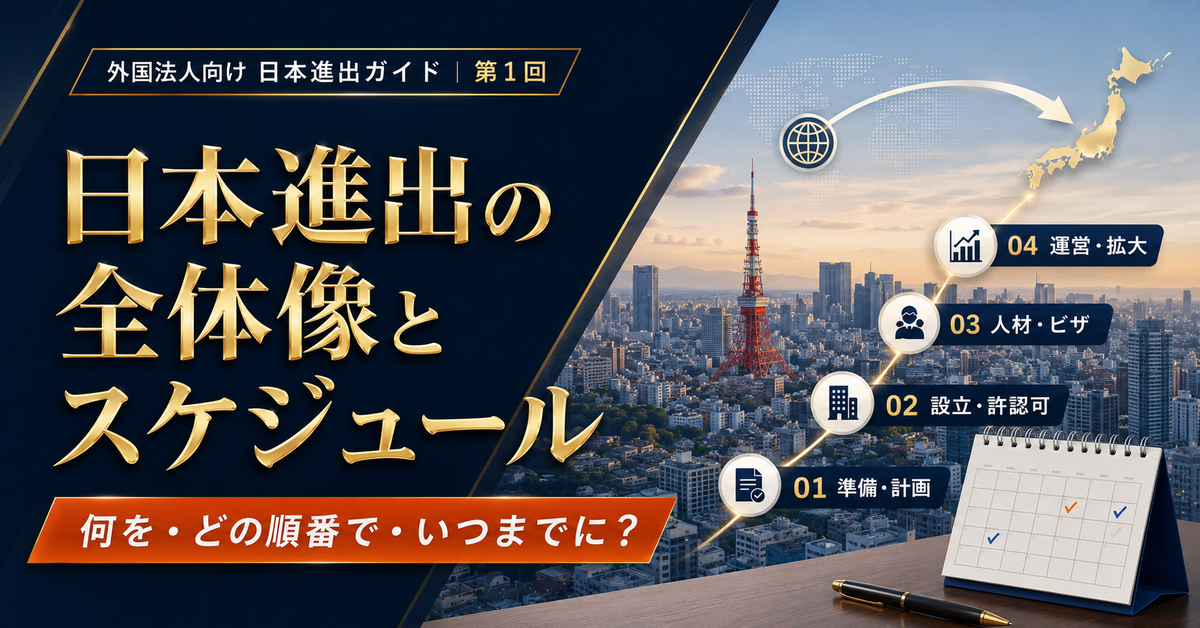
The “Four Phases” of Entry (Roughly This Flow)

  • Phase 1: Deciding the approach and form (a few weeks onward) — organizing the aim of entry, choosing the form, drafting the outline of the business plan
  • Phase 2: Company setup (about 1–2 months) — drafting and notarizing the articles, paying in capital, registration of incorporation, post-incorporation notifications
  • Phase 3: Parallel procedures (licensing, visa, account) (about 2–4 months or more) — license applications, the status-of-residence application, opening the corporate bank account
  • Phase 4: Pre- and post-launch procedures and operation (after incorporation, ongoing) — tax and social-insurance notifications, putting employment contracts in order, starting the business

The point is to run Phase 2 (company setup) and Phase 3 (parallel procedures) “in parallel.” Start only after setup is entirely finished, and the whole thing is pushed back greatly (→ the “in parallel” article).

The “Three Critical Paths” That Delay the Launch If Overlooked

The bottlenecks that fix the overall duration are the three of licensing, the status of residence (visa), and the bank account. All are of the nature that “once you apply, you can only wait for the result,” so rather than starting after setup is finished, advancing preparation as early as possible, in parallel, is the trick to not delaying the entry as a whole.

And what runs through these five areas, four phases, and three critical paths is the cross-cutting consistency of capital, the place of business, the business plan, and business substance. Whether you can watch this consistently is the dividing line for whether you can break the chain of misconceptions.

A Self-Check Before Entry — Review With “Is Our Company OK?”

The 16 misconceptions above can be used as they are as a pre-entry checklist. Check each with “is our company OK?”, and any item that catches even slightly is a point to confirm as a priority. To repeat, these are “information” problems that can be avoided simply by knowing, so catching on something is no problem at all. If anything, noticing early is progress.

In particular, the four points of address (place of business), capital, status of residence, and licensing are cross-cutting issues that bear on several procedures at once. The earlier you settle the approach on these four, the more you reduce rework in later steps. If even one item concerns you, you can sort it out from that point in the free consultation described below.

That Is Why “a Single Point of Contact” — Avoid Misconceptions, Break the Chain

The misconceptions and chains seen so far have a common prescription: having a “point of contact” that watches the whole of entry consistently. Each professional advances their own area accurately, but the cross-cutting coordination across areas, left alone, is carried by no one. Taking that on single-handedly is the role of a single point of contact.

Touch Administrative Scrivener Corporation, as an administrative scrivener firm specializing in international work, coordinates with registration (our partner judicial scrivener), tax (a certified tax accountant), labor matters (a labor and social security attorney), and the checking of the business plan (a certified SME management consultant / certified public accountant / certified tax accountant), and while handling the status of residence and licensing itself, organizes and manages the progress of the whole of entry through a single point of contact. We also handle multilingual communication with your overseas head office. Start with the STEP 0 free consultation. We will hear about your situation, organize whether there are easily-overlooked misconceptions and the overall sequencing, and guide you.

In candor, a single point of contact does not guarantee success. Whether licensing and the status of residence are granted is ultimately the decision of the administrative authorities. Even so, most of the misconceptions seen in this article can, by knowing them and putting things in order cross-cuttingly and early, lower the risk and prevent rework. If concrete support is needed, we will then propose a paid plan appropriate to the content (PHASE 1 onward).

In addition, an industry-specific case study (e.g., the case of a U.S. automobile company building a used-car export base in Japan), which brings this series’ content down to a single near-real company, is also planned for release alongside going forward. If you want to concretely grasp, for your own industry, “in what order you do what in the end,” please refer to that as well.

Start with a free consultation (STEP 0: Free)

Why not begin by sorting out “are there misconceptions our company is overlooking?” and “what to start with?” At Touch Administrative Scrivener Corporation, the first consultation is free. We will hear about your current situation and the aim of entering, and guide you through clearing up misconceptions, the big picture of entry, and how to proceed through a single point of contact. If, as a result of the consultation, concrete support is needed, we will then propose a paid support plan appropriate to the content (PHASE 1: Initial Consulting, from JPY 330,000 [tax incl.], etc.) and carefully explain the cost outlook. Please feel free to get in touch first.

Contact Email: contact@touch.or.jp / Phone: Saitama Office 048-400-2730 / Tokyo Office 03-6825-0994

Related Articles — the Full 12-Part Series

This series is organized along the flow of entry. Read from whichever theme interests you.

Stage 1: Deciding the Form and Company Setup

Stage 2: Parallel Procedures (Licensing, Visa)

Stage 3: Around Launch (Tax, Labor, Account)

Summary

In addition, an industry-specific case study (e.g., the case of a U.S. automobile company building a used-car export base in Japan) will be added in due course.

Note: The content of this article is general information current as of July 2026, and is not legal or tax advice for a specific matter. The requirements, amounts, and tax rules for the status of residence, tax, registration, licensing, the bank account, and so on may differ due to amendments to laws and regulations or individual circumstances. For a specific decision, please check the latest official information from the Immigration Services Agency, the National Tax Agency, the Legal Affairs Bureau, the Financial Services Agency, the Ministry of Finance, the Bank of Japan, and so on, and consult a professional. As for U.S. tax (check-the-box, etc.), please confirm with an accountant or tax professional in your home country. Registration is handled by a judicial scrivener, tax by a certified tax accountant, labor matters by a labor and social security attorney, and the checking of the business plan by a certified SME management consultant, certified public accountant, or certified tax accountant, with the status of residence and licensing handled by an administrative scrivener. Touch Administrative Scrivener Corporation, as a point of contact coordinating with these professionals, organizes and manages the progress of the whole of entry.

Supervisor of This Article

TOUCH Law Firm
Representative immigration lawyer:

Kazuki Yuda

Areas of Expertise
Visas for Foreign Nationals (Residence Status), Naturalization
Main Services

・Application for residence status and naturalization for foreign nationals
・Support for documentation related to foreign investment
 (e.g., Business Manager Visas, Consulting for Foreign Investment in Japan)
・Employment of foreign personnel, management of Technical Intern Training Program, and support for Specified Skilled Worker registration

Since our founding, we have focused exclusively on international procedures, successfully processing more than 1,000 visa and naturalization applications annually.

Official Website
https://touch.or.jp/
日本語・English
Chinese