Business Manager Visa

Why Company Setup, Licensing, and Visas Must Run “in Parallel” — Common Sequencing Mistakes When Entering Japan

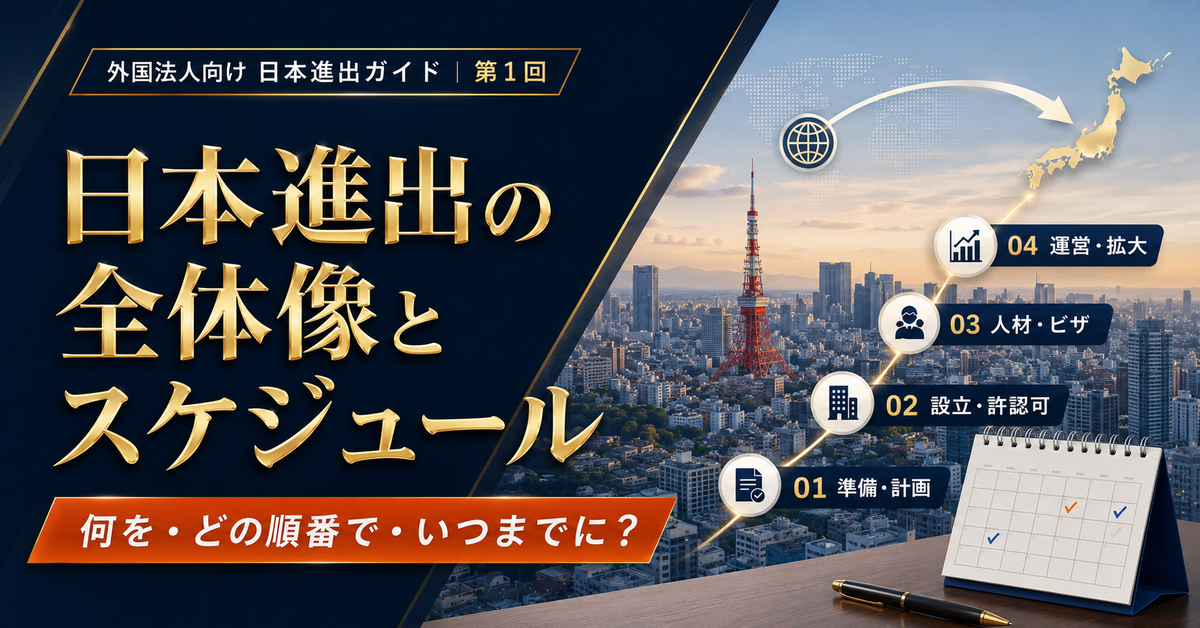
Entering Japan by doing “company setup → licensing → status of residence (visa) → opening for business” in order — and, on top of that, hiring separate professionals for registration, tax, and the visa — this seemingly rational approach is exactly the pattern in which entry tends to stall. The three bottlenecks of licensing, the status of residence, and the bank account can only be handled by “applying and then waiting for the result,” and trying to clear them one after another pushes the whole thing far back. This article explains why “in order, separately” tends to fail, and what to move in parallel and manage consistently — with common failure patterns, route-by-route timelines, and concrete fund routes. An administrative scrivener specializing in international work guides you through it.

Note: The content is current as of July 2026. For the latest, please check official sources and consult a professional.

What you’ll learn in this article

  • Why proceeding “in order, separately” — setup → licensing → visa → opening — tends to fail
  • When the foreign manager themselves comes to Japan to manage, the two entrances — “person-first (four-month visa / Startup Visa)” and “cooperator” — and how the order of setup and the status of residence differs
  • The mechanism by which capital, the place of business, the business plan, and business substance bear on several procedures at once (common failure patterns)
  • How to tell “steps that must be in order” from “steps that can run in parallel,” and route-by-route timelines
  • The concrete fund route for bringing JPY 30 million of capital into Japan (steps and cautions)
  • The “no one is watching the whole” problem, and the solution through a single point of contact and progress management

Why “In Order, Separately” Fails

The heart of failure comes down to a single fact: the “same materials” — capital, the place of business (address), the business plan, and business substance — bear at once on several procedures: setup, licensing, the visa, the account, and tax. A decision at one step governs the result of another. That is exactly why, when you try to clear them one at a time, a later step reveals that “the earlier decision did not meet the requirements,” and rework occurs.

Before That — A Foreign Manager’s Entry Has “Two Entrances”

Before the failure cases, let us sort out one thing. The pattern in which the founder or owner themselves comes to Japan to manage (Pattern B = Business Manager, in the terms of “the three-pattern diagnosis of entry”) has, broadly, two entrances, and the order of “company setup” and “the status of residence (COE / arrival)” is exactly reversed between them. Mistake this, and you misread the whole sequence.

Route A: person-first type (come to Japan first on a status of residence for preparation). The applicant themselves first comes to Japan on a status of residence for preparing to start a business. There are broadly two options here. One is a four-month “Business Manager” (a preparation period that lets you enter before company setup); since after setup you extend the same “Business Manager” period, the last step is not a change of status of residence but an “extension of the period of stay.” The other is the Startup Visa (Designated Activities), a system for staying to prepare a startup on the premise of a municipality’s support and confirmation. This preparation period can also count toward the management experience for Business Manager. Because this is a different status of residence, after setup it becomes a change of status of residence to “Business Manager.” In either case, you proceed: arrival → resident registration → opening a personal account in your own name → paying in capital → company setup → putting substance in order such as the place of business, full-time staff, and the business plan — and finally move to a formal “Business Manager” by an extension (four-month visa) or a change (Startup Visa). Arrival comes first, and company setup comes after. However, after the October 2025 reform, even a status of residence for preparation is required to show, at the application stage, draft articles and a business plan in line with the new standards (capital of JPY 30 million, a business plan checked by a professional, and so on), and the bar for obtaining it has risen. Note in particular that the four-month visa requires a sequence in which, within that four-month period of stay after arrival, you finish everything from setup through the extension application.

Route B: cooperator type (the person is overseas; a cooperator in Japan handles setup). A cooperator who already has an address and a status of residence in Japan handles preparing the incorporator’s personal account, paying in capital, and setup, while the person is overseas. Once the company is in a state that meets the requirements, the person applies for a normal “Business Manager” COE from overseas, obtains a visa, and comes to Japan. Company setup comes first, and the COE and arrival come after. However, as described below, a form in which the person is never involved at all and dumps the building of the vehicle on the cooperator invites doubt about the very substance of management, and can become a core risk of refusal.

To organize: Route A follows [status of residence for preparation → arrival → setup → putting substance in order → extension/change], and Route B follows [setup and putting substance in order (cooperator) → COE → visa → arrival] — the order of “setup” and “arrival” is completely swapped. Read the failure cases, the “in order / in parallel” table, and the timelines below with an awareness of which route your company is on. Note that which route is available and how the requirements are met (especially after the October 2025 reform) vary by individual circumstances, so check with a professional early.

Let us look at representative failure cases (all are common typical examples, not individual clients).

Failure Case ① — A virtual office to cut costs → stuck at the visa (common to both routes)

At the setup stage, contracting a virtual office or a rental meeting room to “hold down fixed costs.” But the Business Manager status of residence requires an “independent place of business,” and a virtual office and the like are, as a rule, not accepted. Because the address bears not only on the company’s registration but also on the visa screening and account opening, stumbling at the first choice of address stops you in a chain at both the visa and the account.

Failure Case ② — Building only the “vehicle” first without the person’s involvement → stuck at the fund stage (typical, mainly Route B)

If, without the person being sufficiently involved in management, you try to build only the “vehicle” of the company first by leaving it to a cooperator, you get stuck at the fund stage in one of the following (or a combination).

  • Setup itself. With the person overseas and neither a Japanese account nor a cooperator, you get stuck on “whose account” to use for the payment at setup (to avoid this, the person-first Route A — the four-month visa, etc. — exists).
  • The increase-of-capital stage. When raising a company set up under the old standard (capital of JPY 5 million) to JPY 30 million, paying in a cash capital increase requires, in registration practice, an account in the company’s name (a corporate account) as a rule. But a foreign-owned, newly established company has not yet opened a corporate account, so the very account to receive the capital-increase payment does not exist — a dead end.
  • The source of funds. Even with a corporate account, you may be unable to bring in the person’s JPY 30 million in a form that shows its source as “the person’s own investment.” Trying to receive it once through the cooperator’s personal account and route it around collapses the explanation of the substance of the investment and the source of funds, and is instead a disadvantage at the visa and account screening (if the home country has foreign-exchange controls, that compounds it).

As a more fundamental problem, a form in which the person is never involved and a cooperator builds only the vehicle invites doubt about the very substance of management. Immigration is understood to treat cases where the actual activity as a manager is not sufficiently recognized — such as through business outsourcing — as not qualifying as “Business Manager” activity, and this is a core risk of refusal that comes before the fund route.

There are four keys to avoiding this. (1) If you set up from scratch after the reform, design the capital at JPY 30 million from the start and avoid the capital increase itself. (2) Make the investor (the person; or, if investing through a home-country company the person controls, that company) the incorporator, and make the payment at setup in that name so that the “source of the investment” can be traced in the records. (3) Move to open a corporate account right after registration. (4) Above all, create a form in which the person is substantively involved in management. Deciding these four together with the design of the status of residence at the very start is essential (for the concrete flow of funds, see “Route-by-route fund routes” below).

Note that when a company under the old standard has no choice but to increase capital, there is also a method that increases capital by DES (a contribution in kind of a monetary claim such as a loan to the company) instead of a cash payment, without going through the corporate account (whether an inspector is required, conflicts of interest, and the explanation of the source of funds require a judicial scrivener’s confirmation before execution).

Failure Case ③ — Plan and substance are inconsistent → flagged as “not matching” (common to both routes)

A case where the business purpose in the articles, the premise for licensing, the business plan checked by a professional, and the actual business substance are each built separately and diverge. At the visa screening, you are flagged that “the plan and substance do not match,” leading to requests for additional materials and a longer screening. The business plan is the “backbone” that runs through setup, licensing, and the visa alike, and trying to unify it afterward becomes major rework.

Failure Case ④ — Hiring first → out of step with the employment requirement (common to both routes)

Hiring people first for labor reasons, only for that personnel to be out of step with the Business Manager employment requirement (at least one full-time staff member; as a rule, those covered are Japanese nationals and people with a status-based status of residence [Appendix II] such as a permanent resident, long-term resident, or spouse of a Japanese national), so the requirement is not met. “Whom to hire, on which status of residence” must be designed together with the visa requirements, not just for labor.

Failure Case ⑤ — “Once the company exists, the rest is in order” — vehicle first, substance behind (common to both routes)

A pattern where registration is complete but the preparation of the business substance needed for the visa — the office, capital, full-time staff, a business plan checked by a professional — falls behind. What matters here is that the timing at which business substance is questioned in the status-of-residence screening differs by route. In Route B (cooperator type), it is at the point of the COE application after setup; in Route A (person-first type), it is at the point of the extension/change application after setup that whether the substance is in place is examined. Either way, with the mindset that “once the company exists, the rest can be put in order in sequence,” the shortage of substance lengthens the screening and, in the worst case, leads to refusal, greatly delaying the opening for business itself. Business substance must be put in order early, in parallel with setup, without waiting for registration to complete.

What these have in common is that a “well-intentioned decision” in one area (setup, labor, cost management) collides with the requirements of another area (visa, account). The more you proceed in silos, in order, the less this collision is visible until a later step.

Telling “What Must Be in Order” from “What Should Run in Parallel”

“So should everything be done at once?” — no. Among the steps, there are those whose order is fixed and cannot be skipped, and those that can run in parallel without waiting for setup to complete. Telling the two apart is the first step of sequencing.

Representative examples that must be in order are (1) the internal flow around funds — paying in capital (incorporator’s personal account) → registration of incorporation → opening a corporate account and transferring the capital (this order is common to Routes A and B) — and (2) the flow of the status of residence. As noted above, (2) changes position by route: in Route B, applying from overseas, the order is “the company meets the requirements → COE issued → visa at the overseas mission → arrival”; in the person-first Route A, it is “come to Japan first on a status of residence for preparation → setup → extension of the period of stay (four-month visa) or change of status of residence (Startup Visa).” In both, you cannot move to the next step until the previous one finishes. On the other hand, there are also many things you do not need to wait for setup to fully complete. Confirming whether licensing is needed and preparing documents, securing an independent place of business, drafting the business plan to be checked by a professional, and designing hiring in light of the employment requirement are steps that should be started in parallel with setup — indeed, early.

Steps that must be in order (cannot proceed until the previous one finishes) Steps that can run in parallel without waiting for setup to complete
Paying in capital (incorporator’s personal account) → registration of incorporation → opening a corporate account and transferring the capital (the internal order is common to Routes A and B) Confirming whether licensing is needed and preparing the necessary documents
The flow of the status of residence (position differs by route): Route B = after setup, COE issued → visa → arrival / Route A = come to Japan first on a status of residence for preparation, and after setup extend the period of stay (four-month visa) or change status of residence (Startup Visa) Securing an independent place of business (property)
Among licenses, those that cannot be applied for until after registration Drafting the business plan to be checked by a professional
Extension of the period of stay / change of status of residence (after arrival and the start of business) Designing and preparing hiring in light of the employment requirement

Note: Even for “steps that must be in order,” their preparation (gathering documents, deciding policy) can be brought forward. What cannot run in parallel is the “order of execution,” not the “preparation.”

Note: The funds side (payment through a personal account, opening a corporate account) presupposes that the incorporator themselves or the cooperator has an address in Japan and has obtained a residence card and a certificate of residence. In Route A the person comes to Japan on a status of residence for preparation and does this themselves; in Route B the cooperator in Japan handles it (the payment at setup can be handled through the cooperator’s account and the like, but opening an account in the person’s own name requires a status of residence).

Route-by-Route Progress Timeline (a Rough Guide)

Laying out “what, when, in what order” for the two routes gives the following. The periods are only a rough guide and vary greatly with the business and the state of the screening authorities.

Rough timing Route A (person-first, four-month visa / Startup Visa) Route B (cooperator type, setup-first)
Months 0–1 Fix the entry policy (form, capital, place of business, status of residence). Fix how to source the funds and start (securing funds already overseas / outbound investment through a home-country company the person controls; in countries where a filing is required, this takes several months) Same as left. Securing funds is started earliest (the starting point of the critical path)
Months 1–3 Apply for the status of residence for preparation (the four-month “Business Manager,” or the Startup Visa = a municipality’s confirmation certificate is needed beforehand). In parallel, prepare the place of business, the professionally checked business plan, and whether licensing is needed Draft and notarize the articles → pay in capital to the account of the cooperator (director at setup) as the place of receipt → registration of incorporation. In parallel, secure the place of business, the business plan, and prepare licensing
Right after arrival Visa issued and arrival (= the start point of the four-month period of stay) → resident registration and residence card → open a personal account in the person’s own name Right after registration, move to open a corporate account (assume difficulty, being foreign-owned and new; to several banks). Secure full-time staff
Within 4 months after arrival Pay in capital (person’s account) → registration of incorporation → open a corporate account → office contract → hire full-time staff → tax notifications → (licensing) → apply to move to a formal “Business Manager” (four-month visa → extension of the period of stay / Startup Visa → change of status of residence) Once the company meets the new standards, apply for COE issuance (screening guide 3–4 months; a lengthening trend after the reform)
After that Extension/change granted → start of business (the extension screening guide is about 1–2 months) COE issued → visa at the overseas mission → arrival and residence card → start of business

Note: For Route A, the narrowness of the four-month window after arrival, and for Route B, the COE screening (3–4 months) and opening a corporate account, each tend to be the rate-limiting step (the critical path).

Route-by-Route Fund Routes — Who, Through Which Account, in What Order

How to “bring JPY 30 million of capital into Japan and pay it in” changes in who carries it and in what order by route. We show it in concrete steps.

Before that, note that the source of funds changes “who the shareholder is.” (1) If the person invests with their own funds already held overseas, the person becomes the incorporator and shareholder, and the remittance is in the person’s name (the typical Pattern B). (2) If the person puts up funds through a home-country company they control (for example, in China this corresponds to that company’s outbound direct investment [ODI] procedure), the investor and shareholder is that home-country company, the Japanese company becomes its subsidiary, and the remittance is in that company’s name and the incorporator is that company (the person obtains “Business Manager” as the representative director). Because this form effectively approaches Pattern A (subsidiary) of “the three-pattern diagnosis of entry”, the status of residence and the shareholding structure must be redesigned from the start. The steps below assume (1) (the person invests with their own funds and becomes the shareholder). If investing through a company as in (2), read “in the person’s name” and “the person as incorporator” in each step as that home-country company.

Route A (person-first) fund route

  • [Before arrival, home-country side] Firm up the source of funds. Use “the person’s funds already overseas,” or outbound investment through a home-country company the person controls (a filing is required in some countries; for example, China’s ODI takes several months for the NDRC/MOFCOM filing plus foreign-exchange registration at the bank). Prepare documents showing the source of funds, such as salary, dividends, business income, or proceeds from the sale of assets.
  • [Arrival] Come to Japan on a status of residence for preparation (the four-month “Business Manager” or the Startup Visa), and obtain resident registration and a residence card.
  • [Person’s account] Open a personal account in the person’s own name. Have the person’s overseas funds arrive in this account, with the remittance name necessarily being the person.
  • [Payment] Pay in JPY 30 million of capital to this personal account (= the incorporator’s account), and prove the payment with a copy of the passbook and the like.
  • [Setup → corporate account] Registration of incorporation → open a corporate account after registration → transfer the capital to the corporate account.
  • [Extension/change] Put the place of business, full-time staff, licensing, and the professionally checked business plan in order, and within the four-month period of stay apply to move to a formal “Business Manager” (the four-month visa is an extension of the period of stay; the Startup Visa is a change of status of residence).

Route B (cooperator type) fund route

  • [Before arrival, home-country side] Same as above. Prepare the funds to invest, from funds overseas or through a home-country company the person controls (a filing for outbound investment is required in some countries). Prepare the source-of-funds documents.
  • [Payment] With the person as incorporator, the payment at setup can use the account of a cooperator with an address in Japan (director at setup) as the place of receipt of the payment. Have it arrive in that account in the person’s name from overseas, so that it can be consistently traced in the records as “the person’s investment” (do not mix it with the cooperator’s personal funds).
  • [Setup] Registration of incorporation. Design the capital at JPY 30 million from the start (the point is to avoid a later capital increase).
  • [Corporate account] Move to open a corporate account right after registration (assume difficulty, being foreign-owned and new; to several banks).
  • [COE → arrival] Once the company meets the new standards (capital, place of business, full-time staff, Japanese, management experience or academic background, and the professional check of the business plan), the person applies for a “Business Manager” COE from overseas, obtains a visa, and comes to Japan.

Note: pitfalls — ① not designing at JPY 30 million from the start and increasing capital later → “a cash capital increase requires a corporate account,” and with the account not yet open you are stuck (Failure Case ②); ② mixing the person’s funds with the cooperator’s personal funds → the substance of the investment and the source of funds collapse.

In addition, allowing a margin so that the amount received does not fall below JPY 30 million is a practical point. Because overseas remittance shrinks with exchange fluctuation, remittance fees, and intermediary-bank fees (lifting charges and the like), sending exactly JPY 30 million in yen terms can leave the received amount short. You need to send with a margin of several hundred thousand yen on top, and when splitting into several transfers, manage it so the total reliably exceeds JPY 30 million. Note that when the person brings in means of payment (cash and the like) exceeding the equivalent of JPY 1 million on arrival, a declaration to Customs is required, and carrying JPY 30 million in cash is neither realistic nor safe in the first place. The concrete way to handle remittance and cash import, and the ways of gathering funds you must not use, are explained in detail in the “The Bank Account” article.

The “No One Is Watching the Whole” Problem

Another pitfall is the “silos” of professionals. In Japan, registration is handled by a judicial scrivener, tax by a certified tax accountant, licensing and the status of residence by an administrative scrivener, and labor by a labor and social security attorney (the check of the Business Manager business plan is done by a certified SME management consultant, certified public accountant, or certified tax accountant). Each professional advances their own scope accurately. The problem is in the “gaps” between them.

How much to set the capital at, where to place the place of business, how to draw the business plan, whom to hire as full-time staff — these issues cross the scopes of several professionals. But each professional’s job is to advance the requested scope, and the role of consistently watching the cross-cutting alignment that spans areas is, if left alone, carried by no one. As a result, premises diverge across the people in charge, and discrepancies arise — “the content the judicial scrivener registered and the business plan shown in the visa application do not match,” “the capital the tax accountant assumed does not fit the visa requirements” — leading to rework, delay, and additional cost.

For a foreign company, with the manager overseas and barriers of time difference and language, the burden of contacting and coordinating each professional individually becomes heavier still. A “no one is watching the whole” state slows the speed of entry and readily invites unexpected stalls and additional cost.

The Right Sequence = a Single Point of Contact and Progress Management

The failure modes so far all stem from “there being no one who surveys the whole, takes the cross-cutting alignment, and designs order and parallelism.” Conversely, the right sequence is simple. A single point of contact surveys the whole entry schedule, takes the alignment of the “issues that bear on several procedures at once” — capital, the place of business, the business plan, hiring — designs “what in order, what in parallel,” and manages the progress. That is all. Concretely, it follows this flow.

  • Fixing the policy (Months 0–1). Align the policy on the form of entry, capital, the place of business, and the status of residence. In particular, first determine whether your company is on the person-first Route A or the cooperator-type Route B (or which is realistic), and fix which of the timelines above you move on.
  • Fixing how to source the funds (start with top priority). “Bringing” the capital itself into Japan can be the bottleneck. For example, in China the annual USD 50,000 foreign-exchange quota an individual can use is for current transactions such as study abroad and travel, cannot be used for overseas investment, and the foreign-exchange route for an individual’s outbound direct investment is not open. The realistic options in this case are “use funds already overseas” or “ODI (an outbound-direct-investment filing) through a home-country company the person controls,” both of which require several months of preparation and proof of the source of funds. On the other hand, in many countries where capital movement is relatively free, such as the U.S. and much of Western Europe, such quotas and prior filings are less of an obstacle, but it remains important to have documents showing the source of funds (salary, dividends, proceeds from the sale of assets, and so on) ready at the time of remittance. Note that in a regulated country, “shortcuts” to evade regulation (using another person’s foreign-exchange quota, splitting remittances into small amounts, fictitious transactions or underground remittance, and the like) are, with the recent strengthening of identity verification, more readily detected, make the source of funds impossible to explain, and become a cause of losing both the status of residence and the account. Because how to source funds changes greatly with the home country’s regulation, it is an issue to confirm early, together with setup.
  • Start early on the three critical paths (in parallel). Licensing, the status of residence, and the bank account are all “apply and then wait” steps. Rather than starting after setup, move them in parallel with setup, as in the timelines above.
  • Align the premises of each professional. Align the premises of the work of the judicial scrivener, tax accountant, labor and social security attorney, and certified SME management consultant / certified public accountant / certified tax accountant (capital, place of business, business plan, hiring), and coordinate consistently so discrepancies do not arise.
  • Ongoing management of progress and requirement fulfillment. Continuously manage the progress of the schedule and the state of requirement fulfillment, and correct early if discrepancies arise.

There is one thing we want to convey in candor. A single point of contact and progress management do not guarantee success. Whether licensing and the status of residence are granted is ultimately the decision of the administrative authorities. However, many of the failure modes seen in this article — the mistaken choice of address, the cooperator-dependent setup and the dead end of a capital increase, the mismatch of plan and substance, the discrepancy between hiring and requirements, the shortage of business-substance preparation — can, through cross-cutting alignment and an early parallel start, have their risk lowered and rework prevented.

With a Single Point of Contact, the Sequencing and Progress Management of the Whole Entry

Touch Administrative Scrivener Corporation, as an administrative scrivener firm specializing in international work, plays exactly this “point of contact” role. Coordinating with our partner judicial scrivener, tax accountant, labor and social security attorney, certified public accountant, and certified SME management consultant, we support — through a single point of contact — the sorting of issues for the whole entry, the design of the overall schedule, and the progress management that aligns the premises of each professional. The application agency and document preparation for the status of residence and licensing are done by an administrative scrivener, and registration, tax, labor, and the check of the business plan are each handled by their professional — with Touch watching the whole across the cuts.

The flow of support is staged. First, a free initial consultation (STEP 0) sorts out the big picture and the issues; as needed, initial consulting (PHASE 1) does the schedule design and issue-sorting; and it proceeds to execution and progress management (PHASE 2). The cost, too, can be started reasonably from within your means.

Start with a free consultation (STEP 0: Free)

“We are hiring registration, tax, the visa, and licensing separately, and no one is watching the whole” — if that is your situation, first tell us where you stand. At Touch Administrative Scrivener Corporation, the first consultation is free (STEP 0: free consultation). We will hear your purpose and plan for entry, and guide you on the direction of the overall sequence — what to advance in order and what in parallel. If, as a result of the consultation, concrete support is needed, we will then propose a paid plan appropriate to the content (initial consulting, etc.) and carefully explain the cost outlook. Please feel free to get in touch.

Contact Email: contact@touch.or.jp / Phone: Saitama Office 048-400-2730 / Tokyo Office 03-6825-0994

Note: The content of this article is general information current as of July 2026, and is not legal advice for a specific matter. The requirements, amounts, and procedures for the status of residence, tax, registration, licensing, the bank account, and so on may differ due to amendments to laws and regulations or individual circumstances. In particular, whether the status of residence and licensing are granted is ultimately the decision of the administrative authorities. For a specific decision, please check the latest official information from the Immigration Services Agency, the National Tax Agency, the Legal Affairs Bureau, and each authority, and consult a professional. Note that registration is handled by a judicial scrivener, tax by a certified tax accountant, labor by a labor and social security attorney, and the check of the business plan by a certified SME management consultant, certified public accountant, or certified tax accountant, with the status of residence and licensing handled by an administrative scrivener. Touch Administrative Scrivener Corporation, as a point of contact coordinating with these professionals, organizes and manages the progress of the whole of entry.

Supervisor of This Article

TOUCH Law Firm
Representative immigration lawyer:

Kazuki Yuda

Areas of Expertise
Visas for Foreign Nationals (Residence Status), Naturalization
Main Services

・Application for residence status and naturalization for foreign nationals
・Support for documentation related to foreign investment
 (e.g., Business Manager Visas, Consulting for Foreign Investment in Japan)
・Employment of foreign personnel, management of Technical Intern Training Program, and support for Specified Skilled Worker registration

Since our founding, we have focused exclusively on international procedures, successfully processing more than 1,000 visa and naturalization applications annually.

Official Website
https://touch.or.jp/
日本語・English
Chinese