Japanese used cars, with their balance of condition, performance, and price, are highly popular around the world. That is exactly why more than a few foreign companies take an interest in the business of “buying used cars in Japan and exporting them to their home country or a third country.” Yet for a foreign company to set up a used-car export base in Japan, almost all of the themes this series has covered individually — choosing the form of entry, company setup, licensing (the secondhand-goods license), the status of residence (the visa), tax (the consumption-tax refund), and the bank account — become intertwined at once within a single business. As the series’ closing piece, this article follows, end to end, how the themes discussed so far in the abstract actually connect in a real business, through a single model case: a U.S. company, Company A, setting up a used-car export subsidiary in Japan. Note that Company A is not a specific real company but a fictional setting to show a typical picture of entry. An administrative scrivener specializing in international work guides you through it in plain terms.
Note: The content is current as of July 2026. For the latest, please check official sources and consult a professional.
What you’ll learn in this article
- Using Company A’s used-car export as the subject, the big picture of how the form of entry, company setup, the secondhand-goods license, the visa, tax, and the account connect within a single business
- A timeline following Company A’s entry in six steps (form → setup → secondhand-goods license → visa → account → export system)
- This case’s biggest issue — how export exemption (0%) and the consumption-tax refund change the profit margin and cash flow (the concrete calculation is the tax accountant’s domain)
- The practical flow specific to used-car export (provisional registration of export deregistration / Certificate of Notification of Planned Export / customs and the export permit / the JARC recycling-fee refund)
- A mapping of how all 12 themes of the series bore on Company A’s business (a full review), and how to move on to a free consultation
- First, the Setting — Company A’s “Buy in Japan and Export” Business
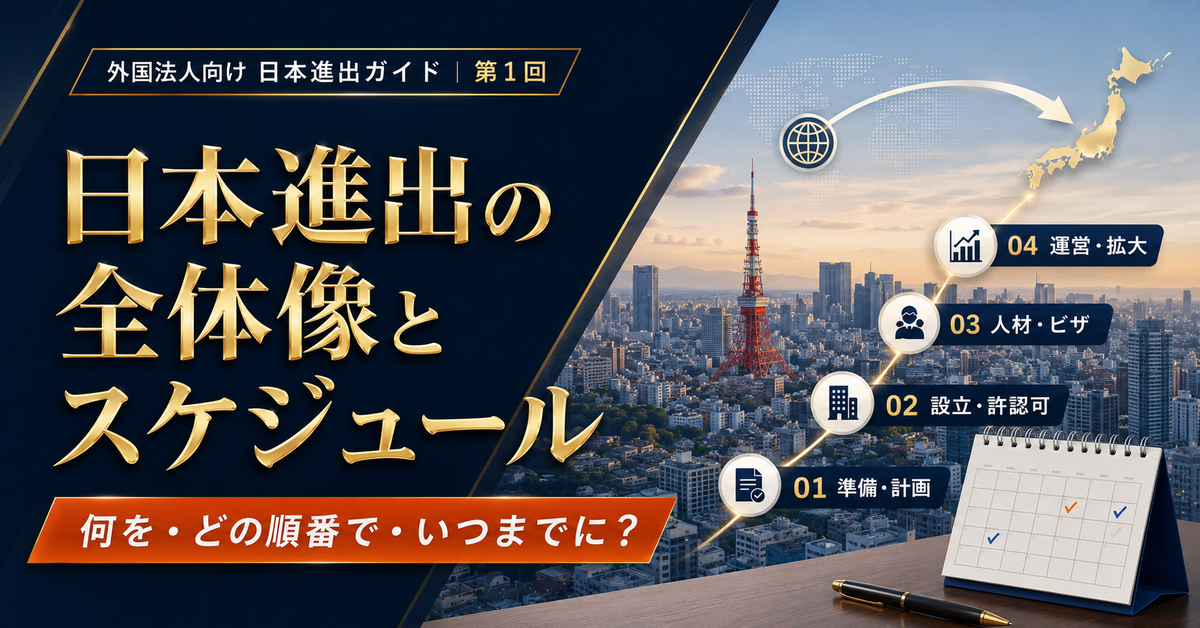
- Following Company A’s Entry in Six Steps
- [The Heart of This Case] The Consumption-Tax Refund Changes the Profit Margin and Cash Flow
- The Practical Flow of Used-Car Export — the District Transport Bureau, Customs, and JARC
- How All 12 Themes of the Series Bore on Company A’s Business (a Full Review)
- Four Pitfalls to Watch Especially in Used-Car Export
- Pitfall ① — Without a secondhand-goods license, you cannot trade or export used cars for business
- Pitfall ② — A virtual office is especially a disadvantage in this line of work
- Pitfall ③ — “Only setup first, with the refund and customs system lagging” leaves capital idle
- Pitfall ④ — In the end, “working in parallel” is fastest
- Division of Roles and a Single Point of Contact — Touch Becomes the “Connecting Point of Contact”
First, the Setting — Company A’s “Buy in Japan and Export” Business
Company A, which sells automobiles in the United States, plans a business of buying used cars and used parts at Japanese auctions and the like and exporting them to its home country (the U.S.) or a third country to sell. Until now it had bought sporadically through local operators, but as transaction volume has grown, it has decided to place its own subsidiary in Japan and build a system for buying and exporting continuously.
The first fork here is “who will run the business in Japan.” If the founder or owner themselves comes to Japan to manage the Japanese subsidiary, the status of residence is basically “Business Manager” (the Business Manager visa). On the other hand, if the head office sends an employee to Japan to carry out local operations, “Intra-company Transferee” is a candidate. However, Intra-company Transferee is, after all, a system for dispatching specialist personnel for a fixed period, and is not a way to send in a manager to run a subsidiary. If the main activity in Japan of the person sent is “the management of the company itself,” then Business Manager, not Intra-company Transferee, is required. In this article, we follow Company A’s entry along the pattern in which the owner comes to Japan to manage (Business Manager).
Note that even in this Business Manager pattern, the entrance to the process splits in two. There is the “person-first type (Route A),” in which the owner comes to Japan first on a status of residence for preparing to start a business (a four-month “Business Manager” or the Startup Visa) and renews/changes the status of residence after setup; and the “cooperator type (Route B),” in which the person stays overseas while a cooperator in Japan handles setup, and once the company meets the requirements, the person applies for a COE overseas and comes to Japan. In the two, the order of “setup” and “arrival” is reversed. The six steps below arrange “what you do” in thematic order, and whether “setup or arrival comes first” actually depends on which route you take. In particular, in the cooperator type, a form in which the person is not involved at all and dumps the building of the vehicle on others invites doubt about the substance of management and becomes a refusal risk, so care is needed.
Used-car export is not a business where, like consulting or software, “you can start doing business as soon as you set up a company.” Buying requires a secondhand-goods dealer license, exporting involves the District Transport Bureau, Customs, and a customs broker, and cash flow is greatly affected by the consumption-tax refund. That is exactly why, rather than advancing each procedure separately, surveying the whole and sequencing it in parallel is what determines the speed of launch and capital efficiency.
Following Company A’s Entry in Six Steps
Organizing Company A’s first year into six steps, in the order of consideration and start, gives the following. What matters is that these do not proceed straight down in a single line, but that setup, licensing, the visa, the account, and the export system are moved in parallel as far as possible.
| Step | What Company A does | Main issue | For details |
|---|---|---|---|
| ① Decide the form and type of company | Enter via a subsidiary, and choose a kabushiki-kaisha (KK) or a godo-kaisha (GK) | Separate legal personality, credibility, ease of account opening | “Subsidiary vs. Branch vs. Rep Office” / “Kabushiki-Kaisha or Godo-Kaisha” |
| ② Set up the company | Drafting and notarizing the articles, paying in capital, registration of incorporation | Capital of JPY 30 million, an independent place of business, a signature certificate | “company registration process” |
| ③ Obtain the secondhand-goods license | Apply for the license essential to buying used cars and used parts | Via the police station / one manager per place of business | “licensing” |
| ④ Put the status of residence in order | Business Manager for the manager, Intra-company Transferee if dispatching | The six requirements / aligning a hired employee’s status of residence with the full-time staff requirement | “Business Manager visa” / “hiring employees” |
| ⑤ Open a bank account | Open a corporate account and move capital and settlements | Explaining business substance / much overseas remittance and forex | “bank account” |
| ⑥ Build the export system | Arranging auction membership, a customs broker, and shipping | Export deregistration / customs and the export permit / the JARC refund | Detailed in the latter half of this article |
Steps ① and ② (form and setup). For Company A, which wants to secure credibility as a separate legal personality and to make overseas remittances and settlements through an account in its own name, a representative office is not suitable (since it can neither do business nor open an account in the company’s name). Setting up a subsidiary with real substance is the basic approach. For the type of company, you choose a kabushiki-kaisha or a godo-kaisha, taking into account social credibility from business partners and banks and future development. Because the owner comes to Japan on the Business Manager visa, capital of JPY 30 million is one benchmark. Furthermore, since it handles used cars — physical “goods” — not only an office for negotiations and documents but also securing space to store and display vehicles temporarily becomes an issue. A virtual office tends to be a disadvantage for the visa’s “independent place of business” requirement, for account opening, and for the practicalities of storage. An officer living overseas cannot obtain a Japanese seal certificate, so a signature certificate is prepared in the home country (an apostille as needed).
Step ③ (secondhand-goods license). To buy used cars and used parts as a business and to trade and export them, a secondhand-goods dealer license under the Secondhand Goods Business Act is required. The application is made, via the police station with jurisdiction over the location of the main place of business, to the prefectural Public Safety Commission. Appointing one manager per place of business is also a feature, and it takes roughly 40 days from application until the license is granted (a standard processing period; it varies by police and municipality). In practice, the membership registration for buying vehicles at Japanese used-car auctions (a secondhand-goods license is generally a prerequisite) is advanced in parallel. Since starting to buy before the license notice arrives can amount to unlicensed business, it is important to allow margin in the launch schedule.
Step ④ (status of residence). If the owner comes to Japan to manage, it is the Business Manager visa. After the October 2025 reform, you must satisfy all six requirements: ① capital of JPY 30 million or more; ② the employment of at least one full-time staff member; ③ Japanese ability (either the applicant or a full-time staff member has a B2-equivalent level / JLPT N2 or above, etc.); ④ three years or more of management experience or a master’s in a related field, etc.; ⑤ a business plan checked by one of a certified SME management consultant, certified public accountant, or certified tax accountant; and ⑥ an independent place of business. Note that who can be counted toward the headcount as a ② full-time staff member is, as a rule, someone holding a status-based status of residence such as a Japanese national, permanent resident, long-term resident, or spouse of a Japanese national; a foreign national working on a work status such as Engineer/Specialist in Humanities/International Services is not included. If Company A hires local staff, it needs to design, from the hiring stage, the alignment between that person’s status of residence (Engineer/Specialist in Humanities/International Services, etc.) and the Business Manager full-time staff requirement.
Step ⑤ (bank account). A corporate account is the lifeline of the business, but screening tends to be strict for a foreign-owned, newly established company with a foreign representative. Used-car export in particular is a line of work with much overseas remittance and foreign exchange, whose flow of money is apt to be seen as complex. That is exactly why preparation to explain business substance concretely (office, inventory, business partners, the ins and outs of funds) is important. Whether the account opens is ultimately the bank’s decision.
Step ⑥ (export system). To export the vehicles bought, a series of procedures is required — deregistration at the District Transport Bureau, an export declaration to Customs, and loading. We look at this in detail in “the practical flow of export” in the latter half.
[The Heart of This Case] The Consumption-Tax Refund Changes the Profit Margin and Cash Flow
What greatly sways the profit margin and cash flow in a used-car export business is consumption tax. This is the “heart” of this business, and a point foreign companies would do well to understand.
The mechanism lies in the difference in the “direction of consumption tax” between an export transaction and a domestic purchase. First, an export transaction is treated as “export-exempt,” with a consumption-tax rate of 0%. Even when you sell a car to an overseas customer, no consumption tax to hold arises. On the other hand, when Company A buys used cars at domestic auctions and the like, it is paying consumption tax on that purchase.
Here, a taxable enterprise, by filing, deducts “the consumption tax paid on purchases and the like” from “the consumption tax held on sales” and pays the balance. In the case of export-centered Company A, the consumption tax held is almost 0 (due to export exemption), yet it has paid consumption tax on purchases — that is, it tends to be in a state where “the consumption tax paid is greater,” and it may be able to receive a refund of that difference. This is a mechanism to keep consumption tax once paid domestically from becoming a double burden through export, and it directly affects cash flow and the profit margin.
The mechanism of the consumption-tax refund (a rough image)
① Buy domestically Buy a used car and pay consumption tax (the consumption tax included in the purchase)
↓
② Export overseas Export-exempt, so consumption tax is 0% (no consumption tax to hold arises)
↓
③ File Consumption tax held (≈0) − consumption tax paid = tends to be negative
↓
④ May be refunded Part of the purchase consumption tax paid may come back (= a plus for cash flow and the profit margin)
Note: This is only a simplified image. The actual eligibility and amount vary with the tax rate, transaction conditions, the classification of the supplier, and so on, and the concrete calculation and filing are done by a tax accountant. This article does not guarantee any specific refund amount.
Here there is a point that is actually a tailwind for foreign companies. A newly established company can be exempt from consumption tax for roughly the first one to two periods, but Company A, with capital of JPY 30 million on the premise of the Business Manager visa, falls under “capital of JPY 10 million or more” and becomes a consumption-tax taxable enterprise from its first fiscal year. Because a tax-exempt enterprise cannot receive a refund, being a taxable enterprise from the first year is, for receiving an export refund, actually an advantageous position.
To receive a refund, there are several premises. First, being a taxable enterprise (Company A qualifies from the first year). Second, properly keeping the documents that prove the transaction is an export — the export permit and the like — and the purchase invoices (qualified invoices) and so on (the export permit and the like must be kept for seven years). Note that the handling of invoices requires care depending on the supplier of the used cars and the method of the transaction, and there is also a special provision on the input tax credit for secondhand dealers (the secondhand-dealer special provision), but how these apply and the concrete calculation are the tax accountant’s domain.
Also, a refund filing is said to be a type that readily attracts confirmation and investigation by the tax office. That is exactly why putting the purchase invoices, the export permit, and the B/L (bill of lading) and the like in order and filing accurately is more important than anything.
Pitfall column ① — “a car bought by an individual or bought tax-free” is outside the refund
What is eligible for a refund is a vehicle bought by paying consumption tax (falling under a taxable purchase). For example, for a car that an individual had bought for personal use and that you take over as is, or a vehicle acquired tax-free, the purchase does not include consumption tax in the first place (or does not fall under a taxable purchase), so no refund for that portion is available. Care is needed that “exporting always means a refund” does not hold.
Pitfall column ② — for a refund filing, “document preparation” is everything
Export exemption and a refund are recognized only once you can prove the fact with documents. If the export permit, purchase invoices, B/L, and the like are not in order, a refund may not be recognized, or it may become a problem in a tax investigation. It is important to build, from the start, a practice of organizing and keeping the evidence at each purchase and export.
The Practical Flow of Used-Car Export — the District Transport Bureau, Customs, and JARC
Before sending a vehicle overseas, there are a number of procedures specific to Japan. The core ones are deregistration at the District Transport Bureau, an export declaration to Customs through a customs broker, and the refund of the recycling fee after export. Organizing the flow gives the following.
| Stage | Procedure | Where / who handles it | Point |
|---|---|---|---|
| ① Deregistration | Obtain the provisional registration of export deregistration (certificate) or the Certificate of Notification of Planned Export | District Transport Bureau | A car not temporarily deregistered uses “provisional registration of export deregistration”; a car already temporarily deregistered uses the “Certificate of Notification of Planned Export.” Both can be obtained from six months before the planned export date (mind the validity period too) |
| ② Customs / export declaration | Prepare an invoice and packing list, make an export declaration to Customs → export permission (issuance of the export permit) | Customs broker / Customs | Customs clearance is the customs broker’s specialty. The export permit is an important document for the consumption-tax refund |
| ③ Loading / obtaining the B/L | Load on a RORO ship or a container ship and obtain the B/L (bill of lading) | Shipping company / customs broker | The sequencing changes with the destination and the type of ship |
| ④ Refund of the recycling fee | Request a refund from JARC, attaching the certificate of provisional registration of export deregistration and the like, the export permit, the B/L, and so on | Japan Automobile Recycling Promotion Center (JARC) | A refund can be requested when you export a car for which the recycling fee was deposited. You cannot receive it unless you apply within two years of the export date |
Of these, the customs declaration itself is the customs broker’s specialty. Because the export permit is also an indispensable document for receiving the consumption-tax refund, coordination with the customs broker and the tax accountant is important. Also, the request to JARC for a refund of the recycling fee has a deadline (within two years of the export date), and if forgotten you cannot receive it. Gathering the documents at each export and building the refund request into your operations too prevents you from missing out.
How All 12 Themes of the Series Bore on Company A’s Business (a Full Review)
Finally, we list how each theme of Parts 1–12 of this series bore on Company A’s single business of used-car export. This is also a full review of the whole series. You should be able to see that the themes that looked abstract are in fact closely connected within a single business.
| Series theme | How it bears on Company A’s used-car export business |
|---|---|
| The big picture of entry | The starting point for designing entry along the map of five areas, four phases, and three critical paths (licensing, visa, account) |
| Comparison of forms of entry | Because a separate legal personality, credibility, and an account in the company’s own name are needed, a subsidiary — not a representative office — is chosen |
| Kabushiki-Kaisha or Godo-Kaisha | Taking into account the credibility of business partners and banks and future development, a kabushiki-kaisha (KK) / godo-kaisha (GK) is chosen |
| The company registration process | Capital of JPY 30 million, an independent place of business (+ vehicle storage space), an overseas officer’s signature certificate |
| Licensing | A secondhand-goods license is essential for buying used cars and used parts. It is also linked to membership registration at used-car auctions |
| The Business Manager visa | If the owner comes to Japan, Business Manager (the six requirements). If dispatching, Intra-company Transferee. Aligning the full-time staff requirement with a hired employee’s status of residence |
| Working in parallel | Moving the secondhand-goods license, setup, visa, account, and export system in parallel to speed up the launch |
| Taxes | A taxable enterprise from the first fiscal year = a position that readily receives an export refund. Notifications, filing, and handling investigations |
| Hiring employees | Securing at least one full-time staff member, the employment contract and social insurance, and understanding the dismissal rules |
| The bank account | Because it is a line of work with much overseas remittance and forex, explaining business substance and the flow of money is needed. Eligibility is the bank’s decision |
| The cost of entry | A sense of the cost of setup, office, visa, secondhand-goods license, tax advisory, and so on (our plans’ setup cost is JPY 515,000 for a kabushiki-kaisha, JPY 463,000 for a godo-kaisha [tax incl.], etc.). The JPY 30 million capital is “separate” |
| Misconceptions and summary | Avoiding misconceptions such as “you can do business once you set up” and “two years of consumption-tax exemption,” and using it for a final check |
Four Pitfalls to Watch Especially in Used-Car Export
Pitfall ① — Without a secondhand-goods license, you cannot trade or export used cars for business
It is easy to think “since we only export, a domestic license shouldn’t be needed,” but as long as you buy secondhand goods as a business and resell/export them, a secondhand-goods license is a prerequisite. Buying before the license carries the risk of unlicensed business.
Pitfall ② — A virtual office is especially a disadvantage in this line of work
Not only can it not meet the “independent place of business” requirement of the Business Manager visa, but at account opening the substance of the place of business is questioned, and handling used cars — physical “goods” — also requires a place to store and handle vehicles. The choice of address chains to the visa, the account, and storage alike.
Pitfall ③ — “Only setup first, with the refund and customs system lagging” leaves capital idle
An export refund is premised on being a taxable enterprise and on document preparation. Set up only the company, and if the operations to gather the purchase invoices, the export permit, and the B/L, and the system with the customs broker, are not in place, the refund you should receive is delayed, and the funds equal to the consumption tax used on purchases sit idle for a long time.
Pitfall ④ — In the end, “working in parallel” is fastest
The secondhand-goods license, company setup, visa, account, and export system all have times of “waiting for a result after applying,” or relationships that depend on an earlier step. Try to clear them one by one in order, and the whole is pushed back greatly. Moving them in parallel as far as possible and aligning them cross-cuttingly is the trick to speeding up the launch.
Division of Roles and a Single Point of Contact — Touch Becomes the “Connecting Point of Contact”
In a business like used-car export, the professionals involved are divided among several. Organizing the division of roles in this case gives roughly the following. The application for the secondhand-goods license and the Business Manager (or Intra-company Transferee) status of residence are taken on directly by Touch Administrative Scrivener Corporation. The company’s registration of incorporation is handled by our partner judicial scrivener, tax including the consumption-tax refund filing by our partner tax accountant, and the export customs procedures by a customs broker, each as their specialty.
Arrange scattered professionals separately, and you tend to end up in a state where “no one is watching the whole.” Because capital, the place of business, the business plan, business substance, and the flow of money bear at once on several procedures — setup, licensing, the visa, the account, tax, and the export system — a presence that watches the whole consistently is indispensable. Touch Administrative Scrivener Corporation, as an administrative scrivener firm specializing in international work, becomes the “connecting point of contact” that coordinates with these professionals, and advances everything from choosing the form to launching company setup, the secondhand-goods license, the visa, the account, and the export system — sorting out the order and the roles while watching the overall schedule. We also handle multilingual communication with your overseas head office.
In candor, we cannot guarantee the consumption-tax refund, or whether licensing and the status of residence are granted. Whether a refund is available is decided case by case by the tax office, and whether licensing and the visa are granted is ultimately the decision of the administrative authorities. Even so, by putting the issues seen in this article in order early and across departments, you can lower the risk of rework and idle capital.
“For our industry, where are the key points?” — why not start with a free consultation (STEP 0) to sort exactly that out concretely?
Start with a free consultation (STEP 0: Free)
Why not begin by sorting out “to launch our business (used-car export, etc.) in Japan, what to advance and in what order?” At Touch Administrative Scrivener Corporation, the first consultation is free. We will hear about your business and your entry plan, and guide you through the big picture of the procedures — including the secondhand-goods license and the status of residence — and how we work with our partner judicial scrivener, tax accountant, and customs broker. If, as a result of the consultation, concrete support is needed, we will then propose a paid support plan appropriate to the content (PHASE 1: Initial Consulting, from JPY 330,000 [tax incl.], etc.) and carefully explain the cost outlook. Support for the secondhand-goods license is JPY 77,000 (tax incl.; statutory fees separate). Note that tax (the consumption-tax refund filing) is handled by our partner tax accountant, customs by a customs broker, and registration by our partner judicial scrivener. Please feel free to get in touch first.
Contact Email: contact@touch.or.jp / Phone: Saitama Office 048-400-2730 / Tokyo Office 03-6825-0994
Note: The content of this article is general information current as of July 2026, and is not legal or tax advice for a specific matter. The requirements, amounts, tax rules, and procedures for the status of residence, tax, customs, registration, licensing, the bank account, and so on may differ due to amendments to laws and regulations or individual circumstances. In particular, whether a consumption-tax refund is available is decided case by case by the tax office. For a specific decision, please check the latest official information from the National Tax Agency, Customs, the District Transport Bureau, the Japan Automobile Recycling Promotion Center (JARC), the Immigration Services Agency, and each authority, and consult a professional. Note that the consumption-tax filing is handled by a tax accountant, export customs by a customs broker, and the company’s registration of incorporation by a judicial scrivener, with the secondhand-goods and other licensing and the status of residence handled by an administrative scrivener. Touch Administrative Scrivener Corporation, as a point of contact coordinating with these professionals, organizes and manages the progress of the whole of entry.