


You have set up a company in Japan — but “which taxes do I pay, when, and to whom?” This is a question we hear without fail, before and after incorporation, from foreign companies and from anyone hoping to run a business in Japan. Japanese corporate taxation combines national taxes such as corporation tax with local taxes paid to the prefecture and the municipality, and a series of deadline-bound notifications begins the moment the company is registered. Open for business without knowing the whole picture, and it is easy to miss a filing deadline or to be squeezed by tax payments you never budgeted for. In this article, we lay out the full picture of the taxes a foreign company pays in Japan — divided into corporation tax, consumption tax, and local taxes — from the notifications due right after incorporation through to the annual filing (specific tax matters, such as calculating the tax itself, are handled by our partner certified tax accountants).
What you’ll learn in this article
- Why a company ends up with several numbers (Corporate Number, the representative’s My Number, the Residence Card number) — and how they differ
- The deadline-bound notifications due right after incorporation (Notification of Corporation Establishment = within 2 months, and others), and what you lose by missing them
- The main taxes charged each fiscal year (corporation tax, consumption tax, local taxes), and the filing and payment deadline of 2 months from the fiscal year end
- The basics of consumption tax, and why a foreign subsidiary is likely to be a taxable enterprise from its very first year
- An introduction to cross-border tax issues (transfer pricing, withholding on dividends, the global minimum tax), and how to move on to working with a tax accountant or booking a free consultation
- First, Some Housekeeping — Why Does a Company End Up With Several “Numbers”?
- The Deadline-Bound Notifications Due Right After Incorporation
- The Main Taxes Charged Each Year — Corporation Tax and Local Taxes
- The Basics of Consumption Tax — Why a Foreign Subsidiary Is Often Taxable From Year One
- Cross-Border Tax Issues — Three Areas That Call for Specialist Advice
- Tax Is Handled by Our Partner Tax Accountants — a Single Point of Contact, So Setup, Visa, and Tax Don’t Fall Apart
First, Some Housekeeping — Why Does a Company End Up With Several “Numbers”?
When you incorporate in Japan and the representative arrives in the country, a whole set of “numbers” appears. They look alike and are easy to confuse, but each serves an entirely different purpose. Sorting this out at the start makes everything that follows in the tax procedures far easier to grasp.
- Corporate Number (13 digits): One number assigned to the company (the legal entity). It is designated by the National Tax Agency once the company is registered, and is published as a rule (you can look it up online). It is used in tax filings and administrative procedures of all kinds.
- My Number (Individual Number, 12 digits): A number assigned to an individual. The representative receives one after registering their residence in Japan (establishing an address and residing there), and it is used in matters concerning the individual, such as withholding on salary.
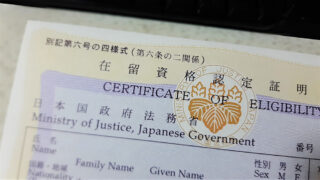
- Residence Card number: The number shown on the “Residence Card” issued to a foreign national staying in Japan for the medium to long term. It relates to the status of residence (the visa) — it is not a tax number.
Not mixing up “the company’s number” with “the individual’s number” — that is the first stumble to avoid in Japanese tax procedures.
Point to watch when entering Japan ① — The difference between the numbers
The Corporate Number belongs to the company, My Number to the individual, and the Residence Card number to the status of residence: their uses are entirely separate. Because some countries abroad issue a single taxpayer number covering both companies and individuals, this is easy to confuse. Note in particular that My Number is issued only once the representative has completed residence registration (notification of address).
The Deadline-Bound Notifications Due Right After Incorporation
Once the company is set up, you begin with notifications to the tax office (and to the prefecture and municipality). Most carry a deadline of “within X months of incorporation,” and missing it puts you at a disadvantage. The main notifications are listed below.
| Notification | Main filing destination | Deadline (guide) | Key point |
|---|---|---|---|
| Notification of Corporation Establishment | Tax office + prefecture and municipality | Within 2 months of the date of registration | Attach a copy of the articles of incorporation, etc. It must be filed with both the national and the local authorities |
| Application for approval of “blue return” filing | Tax office | To have it apply from the first fiscal year, by the day before whichever comes first: the day 3 months after incorporation, or the last day of the first fiscal year | [Filing is optional] You can incorporate without it (you then file a “white return”). But because it is the precondition for tax benefits such as carrying forward losses, in practice virtually every company files it |
| Notification of Establishment of a Salary-Paying Office | Tax office | Within 1 month of establishment | Paying salaries to directors and employees means withholding obligations arise |
| Notification that the company is a newly established corporation for consumption tax purposes | Tax office | When capital is JPY 10 million or more | No separate filing is needed if it is stated on the Notification of Corporation Establishment |
Of these, the one most often overlooked is the application for approval of blue-return filing. Note that this is not a legal obligation: it is an optional application, and if you do not file it you simply file a white return instead (though because it is the precondition for tax benefits, in practice almost every company files it). Blue-return filing brings mechanisms that hold down the tax burden, notably the carryforward of losses, which lets you carry a loss into later years and offset it against future profits. Since the first year of a new company tends to run at a loss, applying within the deadline — so that blue-return filing applies from the very first fiscal year — matters a great deal. Miss the deadline, and blue-return filing is unavailable for that year, along with benefits such as the loss carryforward.
Beyond the notifications listed here, depending on how salaries are paid, there are further documents you may file, such as the “Application for Approval of the Special Provision for Due Dates for Withholding Income Tax.” Which notifications you need varies with the nature of your business and whether you have employees, so it is safest to proceed while checking with a tax accountant.
Point to watch when entering Japan ② — The notifications have short deadlines
Japan’s post-incorporation notifications carry short deadlines — “2 months from incorporation,” “1 month from establishment” — and some must go to both the national authority (the tax office) and the local one (the prefecture and municipality). If confirming matters with the overseas head office takes time, the deadline arrives before you know it. It is therefore important to build the post-incorporation notifications into the company setup schedule from the outset (→ the “parallel work & sequencing” article).
The Main Taxes Charged Each Year — Corporation Tax and Local Taxes
Once a company earns a profit (income), the following taxes arise each fiscal year. Broadly, they split into national taxes such as corporation tax, and local taxes paid to the prefecture and municipality. Here are the main items at a glance.
| Tax | Category | Rate / indicative burden | Notes |
|---|---|---|---|
| Corporation tax | National | 23.2% as a rule. For SMEs with capital of JPY 100 million or less, 15% on income up to JPY 8 million a year (a time-limited measure); 23.2% above that | The 15% rate is a time-limited measure under the Act on Special Measures Concerning Taxation, applying to fiscal years beginning on or before March 31, 2027 (Reiwa 9) |
| Special Defense Corporate Tax | National (new) | (Base corporate tax amount − JPY 5 million a year) × 4% | Applies to fiscal years beginning on or after April 1, 2026 (Reiwa 8). Most SMEs owe zero, but a return must be filed even when the amount is zero |
| Local Corporate Tax | National | 10.3% of the corporation tax amount (the taxable base) | Despite the word “local” in its name, it is paid to the national government |
| Corporate inhabitant tax | Local | A corporation-tax-based portion plus a per-capita levy. The per-capita levy arises even at a loss: roughly JPY 70,000 a year at capital of JPY 10 million or less, and about JPY 180,000 a year at JPY 30 million | The per-capita levy rises with capital and headcount (prefectural + municipal inhabitant tax) |
| Corporate enterprise tax and special corporate enterprise tax | Local | Charged according to income, among other bases | Companies with capital above JPY 100 million fall under size-based business taxation and are taxed even at a loss |
The standard corporation tax rate is 23.2%. SMEs with capital of JPY 100 million or less enjoy a reduced rate of 15% on income up to JPY 8 million a year — but this is a time-limited measure, applying to fiscal years that begin on or before March 31, 2027 (Reiwa 9). And here lies a trap for foreign companies: a subsidiary whose shares are 100% held by a large corporation with capital of JPY 500 million or more may fall outside this 15% reduced rate for SMEs. If your Japanese subsidiary has a large parent, do not leap to the conclusion that “we’re an SME, so it’s 15%.”
From April 2026, the Special Defense Corporate Tax was newly introduced. It is a surtax added on top of the corporation tax amount, calculated by subtracting JPY 5 million a year from the base corporate tax amount (before certain tax credits) and multiplying the remainder by 4%. Where the base corporate tax amount is JPY 5 million a year or less (roughly up to about JPY 24 million of taxable income), the tax comes to zero, so most SMEs bear no real burden. Note, however, that a return must still be filed even when the amount is zero.
On top of these, profits attract Local Corporate Tax (10.3% of the corporation tax amount — despite its name, a national tax), corporate inhabitant tax, corporate enterprise tax, and special corporate enterprise tax. Worth committing to memory is the “per-capita levy” of the corporate inhabitant tax. It must be paid even when there is no profit — that is, even at a loss. The amount varies by bracket of capital and headcount: at capital of JPY 10 million or less it is roughly JPY 70,000 a year (about JPY 20,000 prefectural plus about JPY 50,000 municipal), while a company that sets capital at JPY 30 million for the Business Manager visa falls into the “above JPY 10 million” bracket, at roughly JPY 180,000 a year. The instinct that “no profit means no tax” does not hold in Japan.
The overall burden on profit, once all of these are combined, is called the “effective tax rate.” It varies by municipality and by capital, so no single figure applies; as a guide it runs to roughly 33–35% for SMEs and around 30–31% for large companies (from April 2026, the Special Defense Corporate Tax pushes large companies to roughly the low 31% range). These are ranges and estimates only; the exact amount differs company by company.
The filing and payment deadline — for corporation tax, local taxes, and consumption tax alike — is, as a rule, within 2 months of the day after the fiscal year (taxable period) ends. For a March year-end, for instance, the deadline is the end of May. A special provision lets you extend the filing deadline for corporation tax and the like by one month on notification, and a similar extension is available for consumption tax through a separate notification (what is extended is the filing deadline; the treatment of payment carries caveats, so please confirm the details with a tax accountant). Miss the deadline and penalties such as additional tax and delinquency tax may arise.
Point to watch when entering Japan ③ — Some taxes are payable even at a loss
Abroad, “no profit, no corporate tax” is the norm. In Japan, even at a loss you owe the per-capita levy of the corporate inhabitant tax (about JPY 180,000 a year at capital of JPY 30 million), and if you are a taxable enterprise for consumption tax, that payment obligation remains as well. Precisely because the first year tends to run at a loss, these fixed taxes that arise regardless of profit need to be built into your initial funding plan.
The Basics of Consumption Tax — Why a Foreign Subsidiary Is Often Taxable From Year One
Consumption tax is charged on transactions in goods and services, at a standard rate of 10%, with a reduced rate of 8% for certain items such as food and beverages. A company pays the difference between the consumption tax it collects on sales and the consumption tax it pays on purchases and expenses (if it is a taxable enterprise). Filing and payment fall within 2 months of the day after the taxable period ends, as with corporation tax.
Here is a point foreign companies especially need to know. In Japan, a newly established corporation generally has no base period (the past period used for the assessment) in its first and second fiscal years, so consumption tax is generally exempt (a tax-exempt enterprise). However, if either of the following applies, the company becomes a taxable enterprise for consumption tax from its first fiscal year.
- Capital at incorporation is JPY 10 million or more (→ a taxable enterprise from year one)
- The parent or other controlling party has taxable sales above JPY 500 million, or total sales and revenue above JPY 5 billion (from October 2024 (Reiwa 6), the assessment includes amounts arising outside Japan) — a “specified newly established corporation,” taxable from year one
For the Japanese subsidiary of a foreign company, obtaining the “Business Manager” status of residence (the Business Manager visa) often requires capital of JPY 30 million, which naturally meets the first test of “capital of JPY 10 million or more.” In other words, the Japanese subsidiary of a foreign company is normally a taxable enterprise for consumption tax from its first year, and the benefit familiar to domestic startups — “roughly the first two years are exempt from consumption tax” — is essentially not available. If it also has a large parent, it may qualify as a “specified newly established corporation” as well. This bears directly on the tax and cash-flow plan for year one.
One more thing to grasp on consumption tax is the Invoice System (the qualified invoice retention method). Introduced on October 1, 2023 (Reiwa 5), it requires, as a rule, that you retain a “qualified invoice” in order to deduct the consumption tax paid on purchases (the input tax credit). To issue a qualified invoice you must register as a “qualified invoice issuer,” and registration makes you a taxable enterprise. There are also time-limited measures with set percentages and expiry dates — transitional relief for purchases from tax-exempt enterprises, and burden relief for small businesses (the so-called “20% special rule”) — but because the content changes over time, please confirm the current treatment with a tax accountant. This article goes no further than an introduction.
Note, too, that for export-oriented businesses, the consumption tax refund is a very important part of cash flow. Export transactions are exempt from consumption tax (zero-rated), while the consumption tax paid on domestic purchases may be refunded upon filing. For cases where export exemption and refunds are the core of the business — used-car exports, for example — the detailed treatment is left to our forthcoming sector-by-sector case study (for instance, a U.S. automobile company setting up a used-car export base in Japan).
Point to watch when entering Japan ④ — “The first two years are exempt from consumption tax” often doesn’t apply
Domestically, a newly established company can sometimes be a tax-exempt enterprise for consumption tax for up to about two years — but the Japanese subsidiary of a foreign company is in a different position. Set capital at JPY 30 million for the Business Manager visa and you meet the “capital of JPY 10 million or more” test, making you a taxable enterprise from the very first year. With a large parent, you may qualify as a “specified newly established corporation” too. Plan on the basis that consumption tax filing and payment start in year one.
Cross-Border Tax Issues — Three Areas That Call for Specialist Advice
For the Japanese subsidiary of a foreign company, tax issues arise that do not stay within Japan’s borders. All are highly technical, and wading in unaided is unwise. Here we do no more than make you aware that these issues exist; we recommend leaving the substantive analysis to a tax accountant.
- Transfer pricing rules: Prices in transactions with overseas affiliates (such as the parent) must be on the same terms as transactions with third parties (the arm’s length price). If the pricing is not appropriate, it can become a tax problem later.
- Withholding on dividends to an overseas parent: When a Japanese subsidiary pays a dividend to its overseas parent, Japanese domestic law requires withholding of 20.42% as a rule. A tax treaty may reduce or eliminate this (under the Japan–U.S. tax treaty, for example, the rate may fall to 0%, 5%, or 10% depending on requirements such as shareholding ratio and holding period). The applicable rate depends on the counterpart country, the treaty, and the shareholding ratio — and to obtain the reduction you must file the prescribed notification (the “Application Form for Income Tax Convention”).
- The global minimum tax (Pillar Two): Large multinational groups with consolidated revenue above EUR 750 million have been brought within a 15% minimum-rate regime, phased in from fiscal 2024. It warrants attention if your parent is a large enterprise, but it usually has no direct effect on ordinary SMEs.
Each of these calls for advanced expertise in judging amounts and requirements. How far any of it applies to your company varies greatly with the size of the parent, the nature of the transactions, and your dividend policy — so it is reassuring to consult a tax accountant early and map out what needs to be examined.
Point to watch when entering Japan ⑤ — Withholding on dividends, and tax treaties
When paying profits out as a dividend to an overseas parent, assuming “it’s not taxed at home” and forgetting to withhold can lead to a finding of underpayment in Japan. Domestic law sets 20.42% as the rule, but filing the tax treaty notification by the day before the payment date may secure a reduction or exemption. It is safest to design the timing of the dividend and the treaty procedure with a tax accountant in advance.
Tax Is Handled by Our Partner Tax Accountants — a Single Point of Contact, So Setup, Visa, and Tax Don’t Fall Apart
As we have seen, Japanese tax spans a wide range of issues — from the notifications due right after incorporation, to the annual filing, to consumption tax and international taxation — and it is tightly bound up with the other procedures: company registration, the status of residence (the visa), and labor matters. “How much capital to set,” for instance, is at once a requirement of the Business Manager visa (JPY 30 million), a factor in the consumption tax taxable-enterprise assessment (JPY 10 million or more), and an issue in company setup. Consider tax in isolation, and these lateral connections are easy to miss.
Touch Administrative Scrivener Corporation, as an administrative scrivener firm specializing in international work, organizes the practicalities of entering Japan as a whole and supports you through a single point of contact, coordinating with our partner certified tax accountants, labor and social security attorneys, judicial scriveners, and others. Tax itself is handled by our partner certified tax accountants; registration by a judicial scrivener; labor matters by a labor and social security attorney; and the status of residence and licensing by an administrative scrivener. Touch watches across the whole, sorting out the order and the roles and managing the process so that company setup and the status of residence do not become detached from tax and labor. We also handle multilingual communication with your overseas head office.
Start with a free consultation (STEP 0: Free consultation)
Why not begin by sorting out “which taxes arise in Japan, and when” and “what our company needs to prepare in year one”? At Touch Administrative Scrivener Corporation, the first consultation is free (STEP 0: Free consultation). We will hear about your current situation and your entry plan, and lay out the overall picture of the procedures required — tax included — along with how we work together with our partner tax accountants and other professionals.
If, as a result of the consultation, concrete support is needed, we will then propose a paid support plan appropriate to the content (PHASE 1: Initial Consulting, from JPY 330,000 [tax incl.], etc.) and carefully explain the cost outlook. Specific tax advice and filings are taken on by our partner certified tax accountants. Please feel free to get in touch first.
Contact
Email: contact@touch.or.jp
Phone: Saitama Office 048-400-2730 / Tokyo Office 03-6825-0994